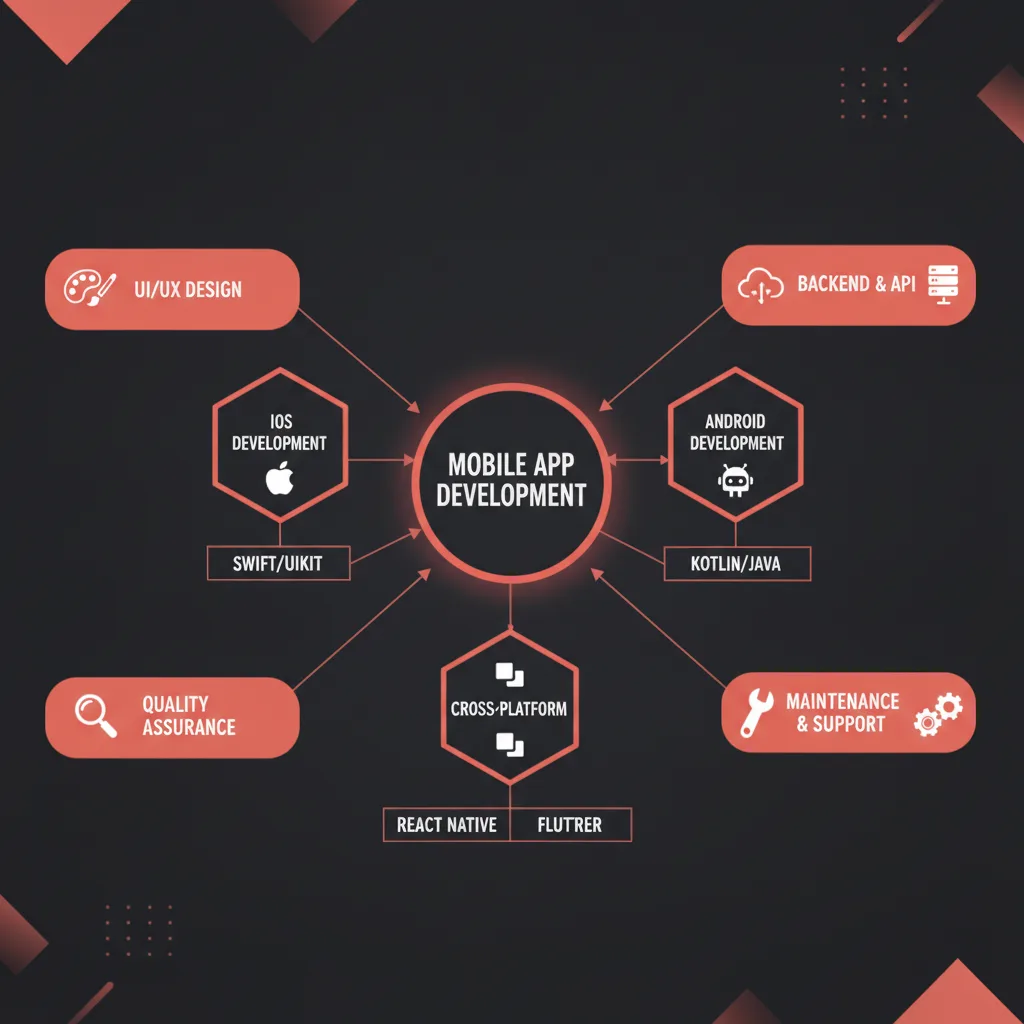
LunexLab delivers mobile app development services that span native iOS and Android applications, cross-platform solutions, and hardware-connected mobile platforms. Our custom mobile app development approach combines architecture planning, full-stack engineering, and real-world product experience—we ship our own consumer VPN (Fubble) alongside client projects that connect mobile dashboards to embedded sensors, robotic controllers, and AI analytics.
LunexLab delivers mobile app development services that span native iOS and Android applications, cross-platform solutions, and hardware-connected mobile platforms. Our custom mobile app development approach combines architecture planning, full-stack engineering, and real-world product experience—we ship our own consumer VPN (Fubble) alongside client projects that connect mobile dashboards to embedded sensors, robotic controllers, and AI analytics.
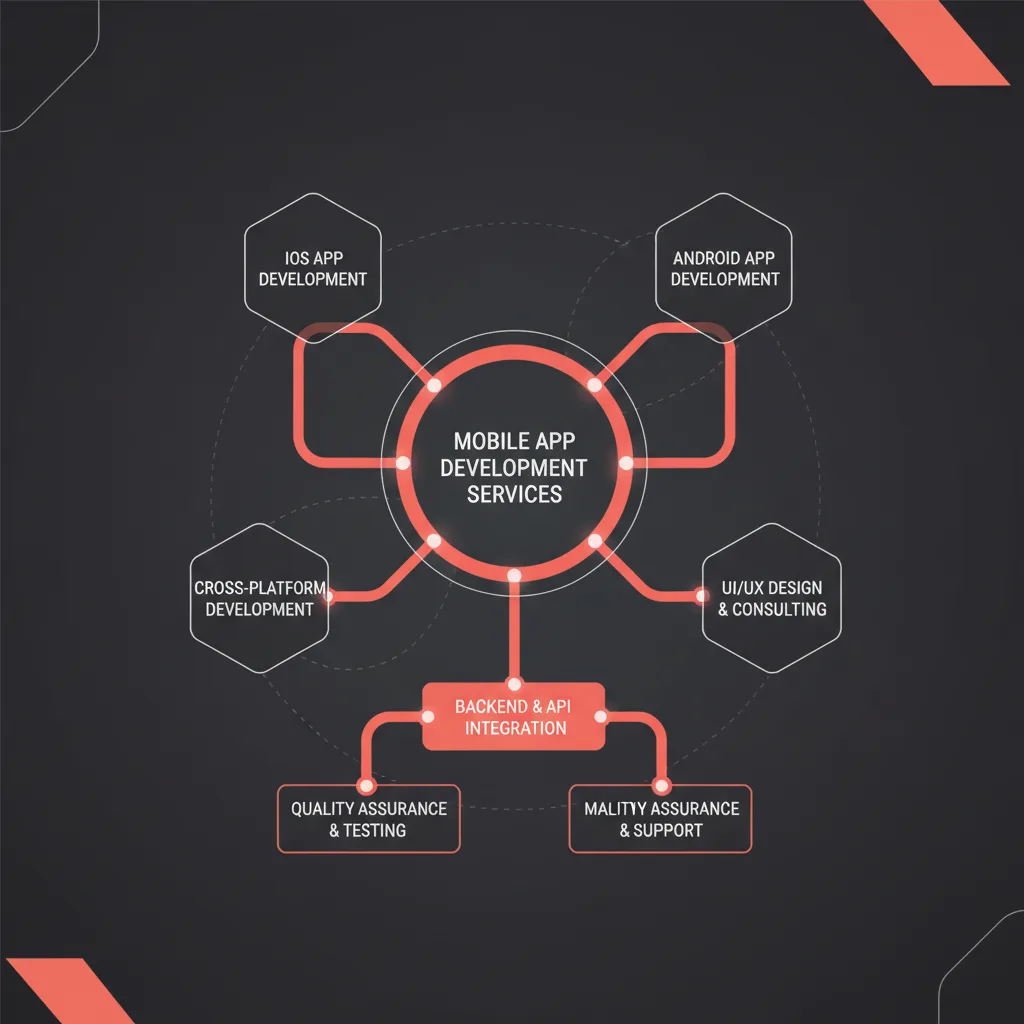
Whether you're launching a startup MVP, integrating mobile control into industrial equipment, or building an AI-native CRM, our mobile app development company brings the technical depth to deliver apps that work in production, not just TestFlight prototypes. We handle Swift and Kotlin for native development, React Native and Flutter for cross-platform speed, and Bluetooth LE, Wi-Fi, and mesh radio protocols for hardware integration.
When you partner with LunexLab for mobile application development services, you work with a team that understands App Store compliance, backend API design, offline-first architectures, and the operational realities of shipping software at scale.
Key Takeaways
- Native and cross-platform expertise: Swift/Kotlin for iOS and Android native apps; React Native and Flutter for unified codebases when speed and maintenance efficiency matter.
- Hardware-connected mobile apps: Bluetooth LE, Wi-Fi, GSM, and mesh radio integration—our Bridge project connects mobile dashboards to STM32 field nodes for real-time structural monitoring.
- Full-stack mobile solutions: Mobile frontend, cloud backend (AWS, Firebase), AI analytics, CI/CD pipelines, and managed deployment through App Store and Google Play.
- Proven product track record: Fubble VPN runs on iOS and Android with WireGuard protocol and 50+ server locations—demonstrating we ship consumer-grade apps at scale, not just client prototypes.
- AI-powered mobile features: On-device ML (Core ML, TensorFlow Lite) and cloud AI integration for intelligent CRM assistants (Helios) and computer vision analysis (Bridge sag detection).
What Are Mobile App Development Services?
Mobile app development services encompass the design, engineering, deployment, and maintenance of applications for iOS and Android platforms. This includes native development using Swift (iOS) and Kotlin (Android), cross-platform frameworks like React Native and Flutter, backend API integration, cloud infrastructure provisioning, and submission to app stores with compliance documentation.
Native vs. Cross-Platform Development
Native apps are built with platform-specific languages and tools—Swift or Objective-C for iOS, Kotlin or Java for Android. Native development offers direct access to platform APIs, optimal performance for graphics-intensive or hardware-heavy use cases, and the most polished user experience aligned with iOS Human Interface Guidelines and Android Material Design. You maintain separate codebases for iOS and Android, which increases development time but maximizes control over platform-specific features.
Cross-platform apps use frameworks like React Native or Flutter to share a single codebase across iOS and Android. This accelerates development timelines by 30–40%, simplifies ongoing maintenance, and reduces cost. Modern cross-platform tools deliver near-native performance and access to device features through plugins or native modules. Cross-platform makes sense for business apps, MVPs, and content-driven products prioritizing rapid iteration over cutting-edge platform optimization.
End-to-End Scope of Mobile App Development
Professional mobile application development services include:
- Discovery and strategy: Requirements gathering, platform choice (native vs. cross-platform), tech stack selection, architecture planning, API design.
- UI/UX design: Wireframes, interactive prototypes, brand-consistent interfaces optimized for touch interaction and mobile screen sizes.
- Development: Agile sprints, peer code reviews, version control (Git), continuous integration and deployment (CI/CD) pipelines.
- Backend and API integration: Cloud services (AWS, Firebase), RESTful or GraphQL APIs, real-time data sync, authentication, database design.
- Testing and QA: Unit tests, integration tests, manual device testing, TestFlight (iOS) and Google Play internal tracks for beta distribution.
- App store submission: Compliance with App Store Review Guidelines and Google Play policies, privacy policy documentation, permission justifications, metadata optimization.
- Post-launch support: Crash monitoring, analytics integration, OS version updates, feature expansion, bug fixes, performance optimization.
LunexLab's mobile app development services cover all phases, informed by our experience shipping Fubble VPN and industrial apps that integrate with embedded hardware.
LunexLab's Mobile App Capabilities
Our mobile app development company delivers native iOS and Android engineering, cross-platform development, hardware connectivity, and AI integration. We apply lessons from building our own consumer VPN to every client project.
Native iOS & Android Development
We build native mobile apps using Swift and SwiftUI for iOS, and Kotlin with Jetpack Compose for Android. Native development delivers optimal performance, full access to platform APIs (camera, biometrics, push notifications, background location, HealthKit, ARKit), and platform-native UI patterns that users expect.
Our native app experience includes:
- Fubble VPN: Native iOS and Android clients with WireGuard protocol integration, keychain and encrypted credential storage, network extension configuration, StoreKit and Google Play Billing for subscriptions, and successful App Store and Google Play compliance.
- App Store and Google Play submission: We handle review processes, privacy policy documentation, permission justifications (VPN configuration, location access), data safety forms, and phased release coordination.
- Platform-specific features: Face ID/Touch ID authentication, iOS widgets and live activities, Android Material You theming, platform-appropriate navigation patterns (tab bars vs. bottom navigation).
Cross-Platform Solutions
For projects prioritizing development speed and unified codebase maintenance, we deliver cross-platform apps using React Native or Flutter. A single codebase reduces initial development time and simplifies feature parity across iOS and Android.
React Native leverages JavaScript/TypeScript and bridges to native modules for device APIs. We use React Native for business apps, MVPs, and products with heavy server-side logic where UI requirements follow standard patterns. The mature plugin ecosystem and strong community support make React Native a reliable choice for rapid iteration.
Flutter uses Dart and custom rendering for pixel-perfect UI control. We choose Flutter when design consistency matters more than platform conventions, or when targeting web or desktop alongside mobile. Flutter's hot reload and declarative UI framework accelerate design iteration.
Both frameworks support comprehensive testing, CI/CD tooling (Fastlane, GitHub Actions, Bitrise), and native module development for hardware integration or platform-specific features.
Hardware-Connected Mobile Apps
LunexLab stands apart from typical app development agencies through our hardware and software integration expertise. We build mobile apps that communicate with embedded devices via Bluetooth LE, Wi-Fi, GSM modules, and mesh radio networks—capabilities rare among pure software agencies.
Case: Bridge structural monitoring Our Bridge project connects mobile dashboards to custom field nodes built on STM32 microcontrollers. The mobile app displays real-time bridge sag maps, synchronizes data from BLE mesh networks, handles offline operation in remote field environments with intermittent connectivity, and integrates AI-powered sag analysis. The app manages BLE pairing workflows, data chunking over low-bandwidth radio links, local SQLite caching, and background sync when connectivity returns.
Case: ForgeKit robotic welding ForgeKit uses a tablet control interface to generate robot control programs for sprinkler and drainage pipe welding. The mobile app communicates with robotic controllers over industrial protocols (TCP/IP, Modbus), provides real-time feedback during welding operations, and integrates a shop operations CRM for job tracking and material inventory.
Hardware-connected apps require deep protocol knowledge (BLE GATT profiles, UART over Bluetooth, TCP sockets, MQTT), firmware coordination with embedded teams, and robust error handling for radio dropout, device pairing edge cases, and power management. These capabilities transfer directly to IoT products, medical devices, industrial control systems, and consumer electronics.
AI-Powered Mobile Features
We integrate AI into mobile apps for intelligent automation, predictive analytics, and natural language interfaces. This includes on-device machine learning (Core ML on iOS, TensorFlow Lite on Android) and cloud AI integration via AWS Lambda, Google Vertex AI, or custom inference endpoints.
On-device ML: We deploy models for image classification, natural language processing, and real-time inference without server roundtrips. On-device processing reduces latency, works offline, and keeps sensitive data local—critical for privacy-focused apps or use cases in low-connectivity environments.
Cloud AI integration: Our Helios CRM features AI sales assistants that analyze contact history and suggest next actions. Bridge uses computer vision and structural analysis models to detect bridge sag anomalies from sensor data streams. These integrations balance on-device performance with cloud-scale compute for complex inference.
For teams exploring AI app development workflows, see our coverage of Google AI Studio and AWS App Studio for backend AI tooling that pairs with mobile frontends. We also maintain tutorials on AI app development studio best practices.
Our Mobile App Portfolio
LunexLab's portfolio demonstrates breadth across consumer products, industrial monitoring, and AI-powered operations platforms. We ship our own apps and solve complex integration problems for clients.
Fubble VPN (Consumer Product)
Fubble VPN is our flagship consumer product—a native iOS and Android VPN client with 50+ server locations across North America, Europe, and Asia-Pacific. The app implements the WireGuard protocol, manages encrypted tunnels, handles automatic reconnection on network changes, and synchronizes subscription state across devices.
Technical highlights:
- Native iOS client: Swift, Network Extension framework, WireGuard library integration, keychain credential storage, StoreKit for in-app purchases and subscription management.
- Native Android client: Kotlin, VPN Service API, WireGuard Android module, account sync via Firebase Realtime Database, Google Play Billing integration.
- Backend integration: RESTful API for server discovery, authentication tokens, usage metering, subscription validation.
- App store compliance: Privacy policy, VPN configuration permission justifications, subscription management flows, data safety and privacy labels.
Fubble VPN proves we understand production app distribution, user acquisition funnels, crash monitoring (Sentry, Firebase Crashlytics), A/B testing, and ongoing maintenance for iOS and Android OS updates and security patches. This experience transfers directly to client mobile app development projects.
Bridge (Industrial Monitoring)
Bridge delivers real-time structural monitoring for bridges and tunnels via custom field hardware and a mobile dashboard. The mobile app connects to STM32-based field nodes over BLE and mesh radios, displays live sag maps with AI anomaly detection, and operates offline in remote locations with intermittent connectivity.
Mobile app features:
- BLE mesh networking: Pair with field nodes, sync data across multi-hop networks, handle mesh topology changes.
- Offline-first architecture: Local SQLite caching, background sync when cellular or Wi-Fi connectivity returns.
- Real-time visualization: Map overlays of sag measurements, laser rangefinder data, accelerometer readings.
- AI integration: Cloud-based sag analysis models, push notifications for structural anomalies, predictive maintenance alerts.
Bridge demonstrates our ability to build hardware-connected mobile apps for industrial use cases where reliability, offline operation, and low-power radio protocols are mission-critical.
Helios (CRM with AI)
Helios is a modern CRM with AI sales assistants. The mobile app provides contact management, pipeline tracking, and AI-generated next-action recommendations. Sales teams use Helios on the go for call logging, meeting notes, and push notifications for follow-up tasks.
Mobile app features:
- Native iOS and Android: Swift and Kotlin with shared RESTful backend API.
- AI assistants: Cloud-based natural language analysis of contact history, suggested email drafts, meeting preparation summaries.
- Offline contact management: Local database sync with server when connected, conflict resolution for concurrent edits.
- Push notifications: Task reminders, deal stage changes, assistant recommendations, calendar event integration.
Helios shows how we integrate AI into mobile workflows without sacrificing performance or user privacy.
Mileline (Courier Operations)
Mileline automates courier payroll from GPS route sheets. The mobile app records driver routes, captures delivery photos for proof-of-delivery, calculates distance-based payouts, and syncs with back-office CRM and payroll systems.
Mobile app features:
- GPS tracking: Background location recording with battery optimization, geofence detection for delivery stops.
- Photo capture: Proof-of-delivery images uploaded to cloud storage (AWS S3), thumbnail generation.
- Offline operation: Local route storage, batch upload when online, retry logic for failed uploads.
- CRM integration: RESTful API sync with dispatch and payroll modules, real-time payout calculation.
ForgeKit (Robotic Welding)
ForgeKit generates robot control programs for sprinkler and drainage pipe welding. The tablet control interface communicates with welding robots in real time, provides program previews, and integrates a shop operations CRM for job and material tracking.
Tablet app features:
- Industrial protocol support: TCP/IP communication with robot controllers, Modbus RTU for auxiliary equipment.
- Real-time control: Program execution, pause/resume, parameter adjustment during welding operations.
- Shop CRM: Job scheduling, material inventory tracking, welding program library, user authentication for shop floor roles.
ForgeKit illustrates mobile-first industrial control systems where the app replaces traditional PLC interfaces with a modern touch UI.
Mobile App Development Process
Our mobile application development services follow a structured process that balances agility with quality control and clear stakeholder communication.
1. Discovery & Strategy
We start with requirements gathering, platform selection (native vs. cross-platform), and tech stack planning. This phase establishes project scope, success metrics, and technical architecture.
- Stakeholder interviews: Understand business goals, user personas, competitive landscape, success metrics.
- Platform choice: Native for performance/hardware-heavy use cases; cross-platform for MVPs, business apps, and rapid iteration.
- Architecture design: Backend API structure, data models, authentication strategy, third-party integrations (payment gateways, analytics, push notifications).
- Project roadmap: Feature prioritization, sprint planning, timeline estimates, resource allocation.
2. Design
UI/UX design produces wireframes, interactive prototypes, and high-fidelity mockups aligned with iOS Human Interface Guidelines and Android Material Design principles. We validate designs with stakeholders and conduct user testing before development begins.
- Wireframes: Low-fidelity layouts to iterate on information architecture and user flows.
- Prototypes: Interactive Figma or Adobe XD prototypes for user testing and flow validation.
- Design system: Component libraries, typography scales, color palettes, icon sets, spacing conventions.
- Responsive design: Layouts optimized for iPhone SE through iPad Pro, Android phones and tablets.
3. Development
Agile sprints deliver working features every 1–2 weeks. We use Git for version control, peer code reviews for quality assurance, and CI/CD pipelines for automated testing and build generation.
- Native development: Swift/Kotlin with Xcode and Android Studio, platform-specific testing frameworks.
- Cross-platform development: React Native or Flutter with shared component libraries, hot reload for fast iteration.
- Backend integration: RESTful or GraphQL APIs, Firebase Realtime Database or Firestore, AWS AppSync, authentication (OAuth, JWT).
- Code quality: ESLint/SwiftLint for style consistency, unit tests, integration tests, code coverage monitoring (>80% target).
4. Testing
QA includes automated unit and integration tests, manual testing on physical devices across iOS and Android versions, and beta distribution via TestFlight (iOS) and Google Play internal tracks.
- Automated testing: XCTest (iOS), Espresso (Android), Jest (React Native), widget tests (Flutter).
- Manual QA: Regression testing, exploratory testing, device compatibility checks (screen sizes, OS versions, hardware variations).
- Beta testing: Invite internal users and external beta testers to TestFlight or Google Play internal/closed tracks for real-world feedback.
- Performance testing: Memory profiling, battery usage analysis, network request optimization.
5. Deployment
We manage App Store and Google Play submission, including compliance documentation, metadata preparation, screenshot generation, and phased release coordination.
- App Store submission: Privacy policy links, permission justifications (camera, location, HealthKit), App Store Connect metadata, screenshots (all device sizes), App Review notes.
- Google Play submission: Content rating questionnaire, data safety form, APK or AAB upload, staged rollout percentage, production release notes.
- Release management: Coordinate launch timing across platforms, monitor crash reports and user reviews, respond to App Review feedback.
6. Post-Launch
Ongoing support covers monitoring, OS compatibility updates, bug fixes, and feature expansion based on user feedback and business priorities. We offer maintenance retainers for continuous improvement.
- Monitoring: Firebase Crashlytics, Sentry crash reporting, analytics dashboards (Google Analytics, Mixpanel, Amplitude).
- OS compatibility: Update for new iOS and Android releases within 2–4 weeks of public availability, deprecate unsupported OS versions.
- Feature iteration: Add features based on user feedback, A/B test new flows, optimize onboarding and conversion funnels.
- Security updates: Patch vulnerabilities, update dependencies, rotate API keys and certificates.
Native vs. Cross-Platform: Choosing the Right Approach
The decision between native and cross-platform development depends on performance requirements, hardware integration needs, development budget, time-to-market constraints, and long-term maintenance plans.
| Factor | Native (Swift/Kotlin) | Cross-Platform (React Native/Flutter) |
|---|---|---|
| Performance | Best—direct access to platform APIs, optimized rendering, minimal overhead | Good—minor overhead from bridge layer (React Native) or custom rendering (Flutter) |
| UI/UX | Platform-native look and feel, automatic adoption of new OS design patterns | Near-native with custom widgets; may lag OS design updates by weeks/months |
| Development Time | Longer—two codebases, separate iOS and Android teams or staggered development | Faster—single codebase, shared components, parallel iOS/Android releases |
| Hardware Access | Full access to BLE, NFC, camera, biometrics, background tasks, HealthKit, ARKit | Good access via plugins; custom native modules required for edge cases or new APIs |
| Maintenance | Separate codebases require duplicate bug fixes, feature implementations, OS updates | Unified codebase simplifies updates, reduces long-term maintenance cost by 30–40% |
| Best For | High-performance apps, hardware-heavy integrations, games, platform-specific features | MVPs, business apps, content-driven products, rapid iteration, budget-conscious projects |
When we recommend native:
- Hardware integration (BLE sensors, industrial controllers, medical devices) requiring low-latency communication and precise protocol control.
- Graphics-intensive apps (3D rendering, real-time video processing, ARKit/ARCore experiences).
- Apps needing cutting-edge iOS or Android features on day one of OS release (new APIs, frameworks, design patterns).
- Long-term products where platform-native UX and maximum performance justify higher development cost.
When we recommend cross-platform:
- MVPs and startups prioritizing speed to market and investor demos with feature parity across platforms.
- Business apps with standard UI patterns (forms, lists, dashboards, navigation).
- Products where unified codebase maintenance and cost efficiency outweigh platform-specific optimization.
- Teams with limited mobile engineering resources or JavaScript/TypeScript expertise.
For broader context on selecting a mobile app development partner, see our guide on best mobile app development agency evaluation criteria.
Industries We Serve
LunexLab's custom mobile app development serves startups, industrial operators, and enterprises across diverse sectors with tailored technical approaches.
Startups & Scaleups
We build MVPs that attract investors, iterate based on user feedback, and scale to production with tens of thousands of users. Our work with Fubble VPN—from concept to App Store launch to ongoing feature expansion—demonstrates our ability to ship consumer-grade apps fast. We help startups choose the right tech stack, avoid over-engineering, plan for growth, and optimize App Store presence for organic acquisition.
Industrial & IoT
Our hardware integration experience makes us a strong partner for industrial mobile apps. Bridge's field monitoring dashboard, ForgeKit's robotic control interface, and embedded BLE/GSM connectivity prove we understand industrial protocols, offline operation requirements, rugged device constraints, and field deployment realities. We integrate mobile apps with PLCs, SCADA systems, sensor networks, and robotic controllers.
Enterprise
We deliver internal tools, CRM systems, and operations platforms for enterprise teams. Helios CRM and Mileline courier payroll illustrate how we integrate mobile apps with existing enterprise systems (ERP, payroll, dispatch) via APIs, data sync middleware, and SSO authentication. We handle enterprise compliance requirements (SOC 2, HIPAA technical controls) and deployment via MDM or private app stores.
Consumer Products
Fubble VPN is our consumer flagship, demonstrating we understand app store optimization, subscription management, in-app purchases, push notification strategies, user acquisition funnels, retention optimization, and customer support workflows. This experience transfers to any consumer-facing mobile app project—whether utilities, content platforms, social apps, or services.
Why Partner with LunexLab for Mobile App Development
LunexLab is not a typical app development agency. We ship our own products, integrate mobile apps with embedded hardware, build AI-native features, and maintain transparent communication about technical tradeoffs—capabilities that set us apart in a crowded market.
We Ship Our Own Products
Fubble VPN runs on iOS and Android with thousands of active users across 50+ server locations. This proves we understand real-world app distribution, App Store and Google Play compliance, crash monitoring, user support workflows, subscription management, and continuous deployment pipelines. When you hire LunexLab, you work with a team that has shipped production apps—not just delivered client prototypes that never reach end users.
Hardware + Software Expertise
Few mobile app development companies combine iOS/Android engineering with embedded firmware and industrial protocol knowledge. Our Bridge project connects mobile dashboards to STM32 field nodes via BLE mesh networks. ForgeKit controls robotic welding equipment through tablet interfaces. This rare blend of skills enables mobile apps that interact with real devices, sensors, controllers, and field equipment—not just cloud APIs.
AI-Native Approach
We integrate AI into mobile workflows from day one, not as an afterthought. Helios CRM features AI sales assistants that analyze contact history and recommend actions. Bridge uses computer vision to detect structural anomalies from sensor data. We apply lessons from AI app development studio tooling to deliver intelligent mobile features without vendor lock-in or dependency on closed platforms.
For teams exploring no-code or low-code AI tools for prototyping, see our reviews of free AI app builder options and best free AI app builder platforms for rapid validation before custom development.
Transparent, Practical Process
LunexLab's brand voice is confident but grounded. We focus on architecture, delivery timelines, and business outcomes—no "award-winning" fluff or vague promises. You get honest effort estimates, clear technical recommendations with tradeoff analysis, and a team that ships working software on schedule.
FAQ
Do you develop both iOS and Android apps?
Yes. We deliver native Swift and Kotlin apps for iOS and Android, or unified React Native and Flutter solutions depending on project requirements and timeline constraints. Our Fubble VPN product runs on both platforms with feature parity, proving we manage simultaneous iOS and Android releases.
Can you integrate mobile apps with hardware devices?
Absolutely. Our Bridge project connects mobile dashboards to STM32 field nodes via Bluetooth LE and mesh radios for real-time structural monitoring. We handle firmware protocols, BLE GATT profiles, data chunking, local caching, and mobile UI. We also integrate with industrial controllers, GSM modules, Wi-Fi devices, and custom embedded systems using TCP/IP, MQTT, Modbus, and proprietary protocols.
How long does mobile app development take?
MVP development typically takes 8–12 weeks for a single platform or cross-platform app with standard features. Production-ready apps with backend integration, third-party API connections, QA across devices, and app store submission require 3–6 months depending on complexity, feature set, hardware integration, and design iteration cycles. We provide detailed timeline estimates after discovery and architecture planning.
Do you handle App Store and Google Play submission?
Yes. We manage app store guidelines compliance, privacy policy documentation, permission justifications (camera, location, health data), metadata preparation, screenshot generation for all device sizes, and release coordination. We've successfully submitted Fubble VPN and client apps to both stores, navigating App Review feedback and Google Play policy updates.
What's your post-launch support model?
We offer maintenance retainers covering bug fixes, iOS and Android OS version updates, security patches, crash monitoring, analytics dashboards, and feature expansion based on user feedback. Retainers are structured as monthly or quarterly engagements with defined hours and SLA response times. We also provide on-demand support for specific updates, integrations, or compliance requirements outside retainer scope.
Get Started with Mobile App Development
LunexLab's mobile app development services deliver native iOS and Android apps, cross-platform solutions, hardware-connected mobile platforms, and AI-powered features tailored to startups, industrial operators, and enterprises. Whether you're launching a startup MVP, connecting mobile dashboards to industrial equipment, or building a consumer product, we bring the technical depth and product experience to ship apps that work in production—not just demo-ready prototypes.
Explore our case studies—Fubble VPN, Bridge, Helios, and ForgeKit—or contact us to discuss your project requirements. We'll recommend the right platform choice, tech stack, and development approach aligned with your business goals, timeline, and budget.
For teams evaluating AI integration strategies, see our tutorials on AI app development studio workflows and platform comparisons of Google AI Studio vs. AWS App Studio for backend AI services that pair with mobile frontends.