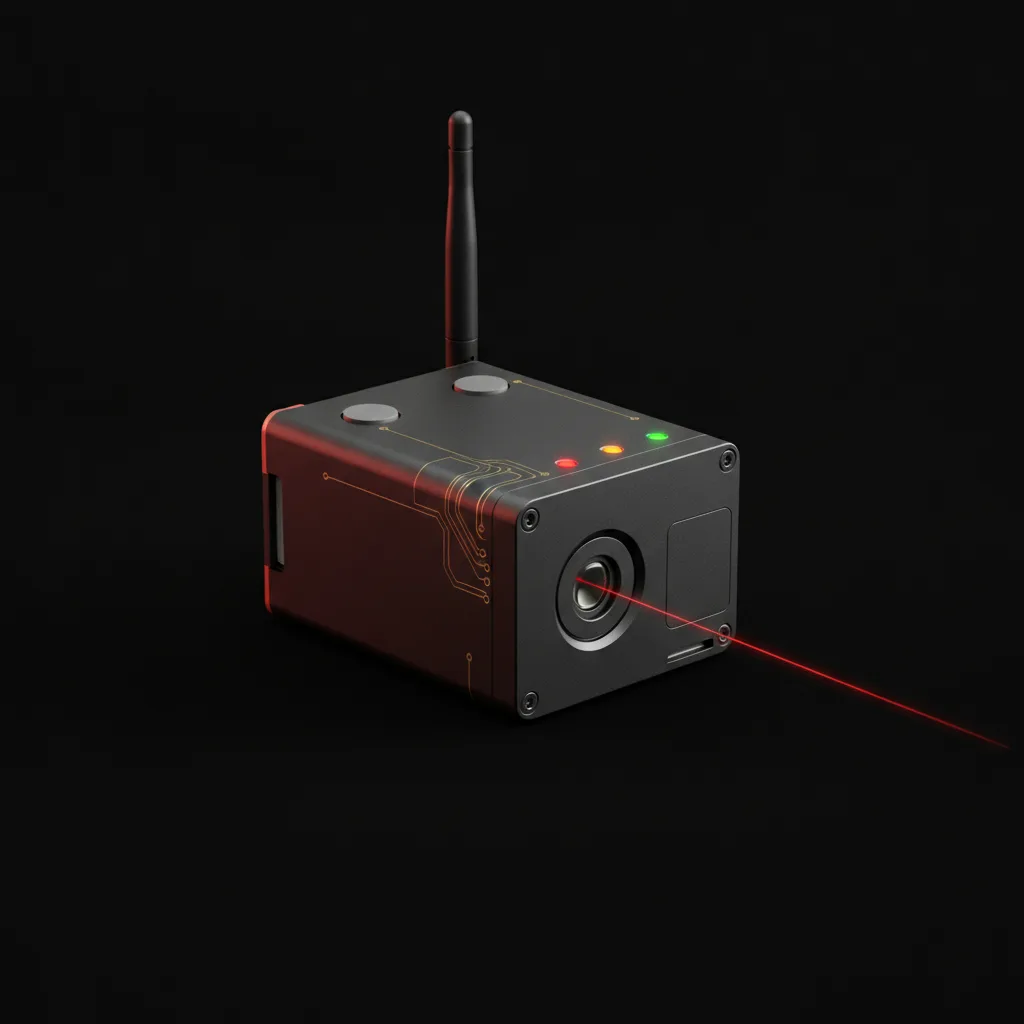

Overview
Bridge is not a dashboard bolted onto someone else’s logger. LunexLab designed the instrument itself: an STM32 node with Bluetooth and Wi-Fi, cellular (GSM) as a wide-area fallback, a battery management system, additional radios so units can join each other, and an SD card for the moments the mesh cannot speak.
Each node carries a laser rangefinder. A span of bridges or a tunnel section becomes a constellation of the same box. Readings leave for a shared backend in realtime; if they cannot, they stack on the card and flush when the path returns. The backend draws a live sag map. Models then look at trends, not just a single millimetre tripwire.
The challenge
Structural monitoring fails in the field for boring reasons: radios drop in steel, power budgets lie, and “cloud-only” loggers lose hours of evidence. Operators still need a map they can trust while a convoy is on the deck.
Approach
- Design the enclosure and board around a pack-sized laser instrument — buttons, antenna, beam, SD — not a lab brick.
- Mesh peer-to-peer so a node can reach the network through its neighbours.
- Store-and-forward on SD when GSM/Wi-Fi/mesh are dark; resume without operator ritual.
- Preprocess at the edge, assemble a live deflection surface in the control system, then run AI on the series.
Hardware stack
| Compute | STM32 MCU, custom firmware |
|---|---|
| Ranging | Collimated laser sensor per node |
| Radios | Bluetooth, Wi-Fi, GSM, additional mesh transmitters |
| Power | Battery + BMS |
| Resilience | SD store-and-forward; peer relay |
| Form | Slightly larger than a cigarette pack |
Outcomes
- A field-ready node we could manufacture as a set, not a one-off prototype.
- Realtime sag maps when the radio path is healthy; no silent gaps when it is not.
- AI analysis on the same stream operators already watch — early structural cues, not a separate science project.