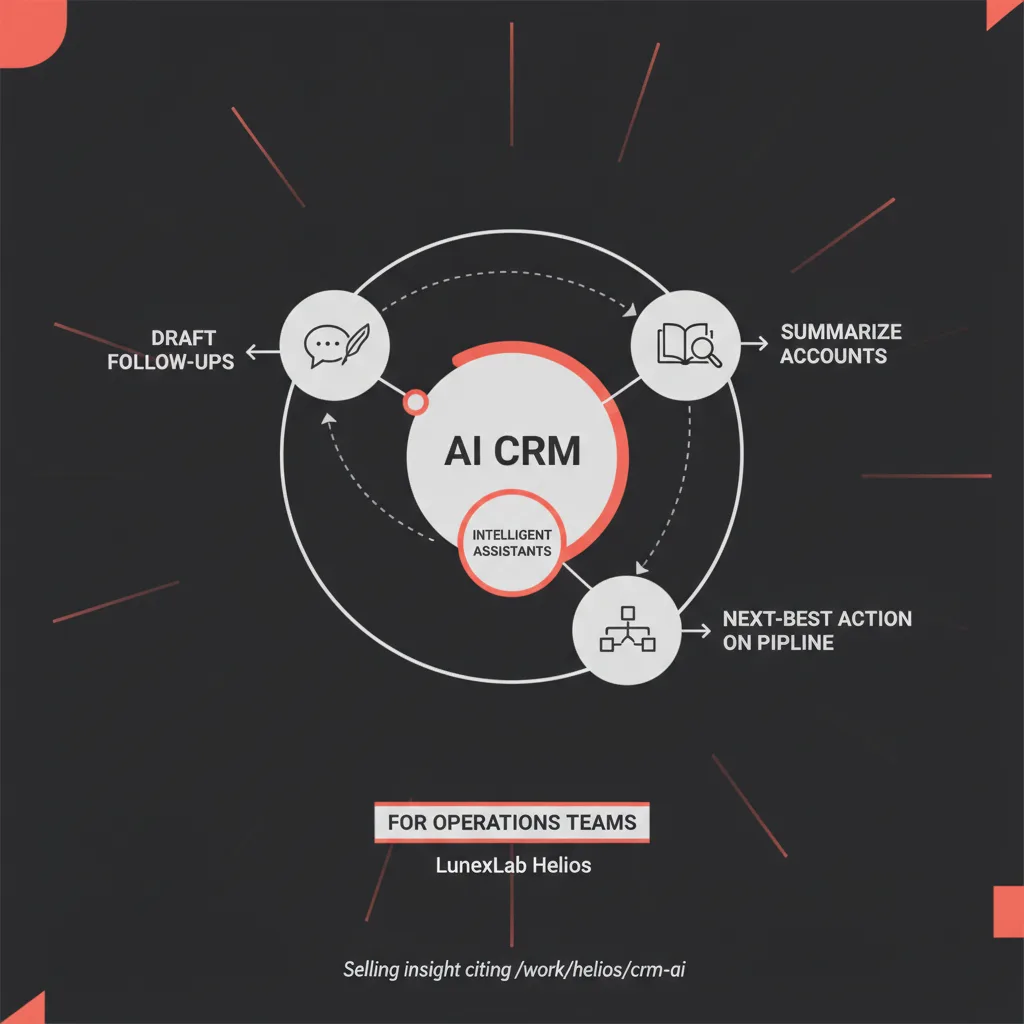
Operations teams managing customer lifecycles, renewals, and fulfillment pipelines face a brutal reality: they spend more time drafting follow-up emails, hunting for account context, and guessing next-best actions than actually coordinating operations. Traditional CRMs capture data—contacts, deal stages, interaction logs—but intelligent assistants *act* on it. They draft context-aware messages, surface account summaries in real time, and recommend pipeline actions based on data patterns. AI CRM with intelligent assistants transforms how operations teams work: automated follow-up drafting, account summarization, and next-best action recommendations free coordinators to focus on customer relationships instead of CRM housekeeping.
Operations teams managing customer lifecycles, renewals, and fulfillment pipelines face a brutal reality: they spend more time drafting follow-up emails, hunting for account context, and guessing next-best actions than actually coordinating operations. Traditional CRMs capture data—contacts, deal stages, interaction logs—but intelligent assistants *act* on it. They draft context-aware messages, surface account summaries in real time, and recommend pipeline actions based on data patterns. AI CRM with intelligent assistants transforms how operations teams work: automated follow-up drafting, account summarization, and next-best action recommendations free coordinators to focus on customer relationships instead of CRM housekeeping.
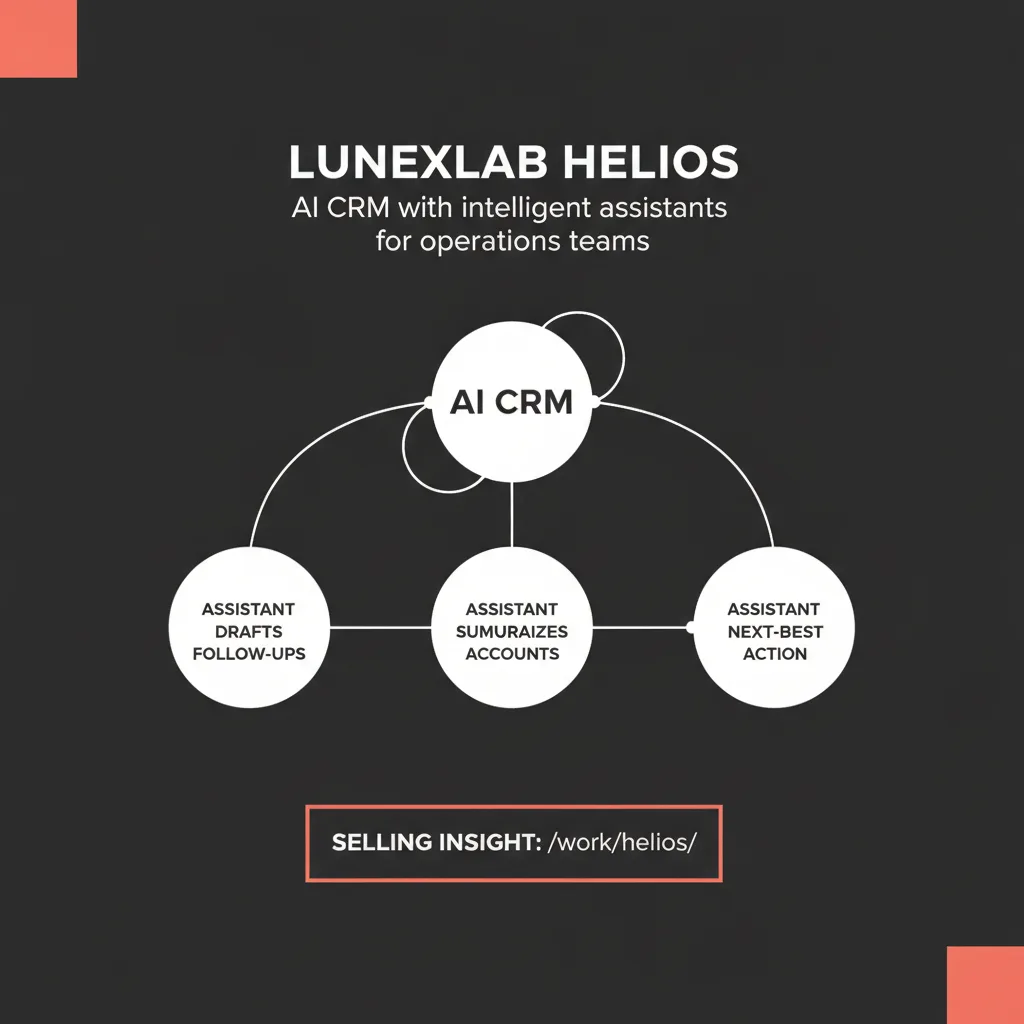
LunexLab Helios is an AI CRM with intelligent assistants built for operations teams: account coordinators, fulfillment managers, renewals specialists, and ops leaders managing multi-stage workflows beyond simple sales closing. The system automates selling admin—follow-up drafting, account summarization, next-best action recommendations—reducing manual overhead while preserving human oversight and compliance control.
Key Takeaways:
- Intelligent CRM assistants automate follow-up drafts, account summaries, and pipeline next-best action recommendations—reducing manual admin for operations teams by 40–60%.
- LunexLab Helios serves ops workflows: account coordinators, fulfillment managers, and renewals specialists managing complex customer lifecycles, not just sales reps chasing deals.
- Proven in production: Helios ships next-best action intelligence and assisted drafting validated in real ops environments, informed by LunexLab's broader industrial platform experience.
- Evaluation criteria: Assess autonomy level (assisted vs. fully automated), pipeline integration depth, next-best action logic, adoption risk, and pricing transparency before committing to an AI CRM platform.
What Is an AI CRM with Intelligent Assistants?
An AI CRM with intelligent assistants combines traditional customer relationship management—contact records, deal pipelines, interaction history—with automation that acts on behalf of operations teams. Rather than forcing coordinators to manually draft every follow-up email, hunt through conversation logs for account context, or rely on gut feel for pipeline next moves, intelligent assistants automate these workflows while preserving human oversight.
Core Intelligent Assistant Capabilities
Modern intelligent CRM assistants deliver four foundational capabilities that transform operations team productivity:
Automated follow-up drafting: The assistant drafts email replies, schedules check-ins, and updates CRM records after conversations—pulling context from recent call notes, deal objections, and contract terms. Operations teams review and edit before sending, maintaining compliance and tone control while slashing drafting time by 60–80%.
Account summarization engine: Instead of tabbing through CRM fields, email threads, and Slack channels to piece together deal history, the assistant surfaces one-click digests: recent interactions, open issues, contract status, escalation triggers, and risk signals. Coordinators get instant account intelligence mid-meeting or before customer calls—eliminating context-switching overhead.
Next-best action recommendations: The CRM analyzes pipeline stage data, account health scores, and workflow rules to suggest optimal next moves: "Request contract review," "Escalate to ops manager," "Assign fulfillment coordinator." This shifts ops teams from reactive (waiting for customers to complain) to proactive (addressing issues before they escalate).
CRM data enrichment: Meeting notes, call transcripts, action items, and email summaries automatically populate structured CRM records. The assistant transforms unstructured comms into queryable data, reducing manual logging overhead and improving pipeline visibility across the organization.
Why Operations Teams Need More Than Sales Assistants
Early AI CRM assistants targeted sales development reps: automating outbound cadences, logging cold calls, and tracking demo follow-ups. Those tools optimize for deal velocity—closing faster, logging more touches, maximizing pipeline throughput. Operations teams coordinate different workflows.
Account coordinators manage renewals, fulfillment handoffs, support escalations, and cross-functional dependencies. Fulfillment managers track resource allocation, delivery timelines, and customer onboarding stages. Renewals specialists juggle contract negotiations, upsell opportunities, and churn risk signals.
Intelligent assistants for operations teams must handle multi-stage pipelines (not just linear sales funnels), account health scoring (beyond deal probability), and resource allocation logic (who handles what, when). LunexLab built Helios to serve these broader ops workflows, informed by the studio's experience shipping industrial and operations platforms—not just CRM-for-sales-reps tools.
LunexLab Helios: AI CRM Built for Operations Intelligence
LunexLab Helios is a modern AI-powered CRM with intelligent assistants designed for operations teams managing complex customer lifecycles. The platform automates follow-up drafting, account summarization, and pipeline next-best action recommendations—capabilities proven in real ops environments, not vaporware marketing promises.
Helios Intelligent Assistant Features
Helios delivers four core intelligent assistant capabilities tailored for ops team workflows:
#### Follow-Up Drafting Engine
Context-aware email and message generation pulls from deal stage, account history, recent call notes, and team annotations. The assistant drafts replies addressing specific customer objections, contract terms, or fulfillment timelines. Coordinators review, edit for tone, and send—maintaining personalization while eliminating blank-page drafting friction.
The drafting engine integrates structured CRM data (contact role, deal stage, contract renewal date) with unstructured comms (call transcripts, email threads, support ticket summaries). Example: "Here's the updated pricing for the enterprise tier you asked about on our last call, along with the contract amendment addressing the fulfillment timeline concerns we discussed."
#### Account Summarization Interface
One-click digests surface open issues, recent touchpoints, contract renewal dates, escalation triggers, and account health scores. Mid-meeting or pre-call, coordinators get instant context without tabbing through CRM fields or searching email threads. The summarization engine integrates structured CRM data with unstructured comms (call transcripts, Slack messages, support tickets).
Real-time intelligence extends beyond meetings. Before a renewal negotiation call, the coordinator pulls a summary: contract end date, upsell opportunities (based on product usage patterns), recent support tickets (potential churn signals), and recommended next-best actions ("Offer 15% discount for early renewal commitment").
#### Pipeline Next-Best Action Recommendations
Rule-based and ML-driven logic suggests stage transitions, resource assignments, and escalation triggers. Examples:
- "Account idle 14 days in 'Proposal Sent' stage → recommend follow-up call."
- "High-value renewal due in 30 days → assign dedicated account manager."
- "Support ticket escalated twice in 7 days → flag churn risk, suggest ops review."
Ops teams get proactive guidance instead of reacting to pipeline stalls or customer complaints. The recommendation engine surfaces guidance when coordinators open accounts or review pipelines—no buried analytics dashboards or manual report generation.
#### Integration with Broader Ops Workflows
Helios was built by LunexLab, a studio that ships operations platforms—not just CRM-for-sales tools. Mileline integrated CRM with courier payroll automation (route data → payout calculations). ForgeKit combined CRM-like shop ops tracking with robotic welding program generation (job scheduling, resource allocation).
Helios synthesizes these learnings: CRM pipeline intelligence tied to fulfillment handoffs, resource allocation logic, and cross-functional coordination—core ops team workflows beyond traditional sales CRM use cases.
Case Study Snapshot
LunexLab Helios is built for operations coordinators on renewal pipelines as much as for closers — assistants that draft, summarize, and propose next-best actions, with a human confirm before anything leaves the building.
Real-world adoption validated assisted automation (draft-and-review) over fully autonomous messaging, addressing ops teams' need for compliance gates and tone control. Coordinators maintained oversight while eliminating drafting friction—balancing efficiency with operational control requirements.
How Intelligent CRM Assistants Remove Selling Admin
Operations teams spend hours per week on CRM admin: drafting follow-ups, searching for account context, guessing pipeline next moves. Intelligent assistants automate these workflows without sacrificing personalization or control—freeing coordinators to focus on customer relationships and cross-functional coordination.
Automating Follow-Ups Without Losing Personalization
Generic auto-responders fail because they ignore context: recent conversations, deal objections, contract terms, account history. Helios's follow-up drafting engine pulls from structured CRM data (deal stage, contact role, contract renewal date) and unstructured comms (call notes, email threads, support ticket summaries).
The assistant drafts replies addressing specific customer questions—"Here's the updated pricing for the enterprise tier you asked about on our last call"—not vague "just checking in" messages that damage customer relationships.
#### Assisted Automation Model
Operations teams review drafts before sending. This assisted automation model preserves:
- Tone control: Formal contract language vs. casual check-ins based on account type and relationship history.
- Compliance gates: Legal review for MSAs, pricing approvals, contract term modifications requiring executive sign-off.
- Relationship nuance: Flagging sensitive accounts for manual drafting (at-risk renewals, escalated support issues, executive sponsor relationships).
Coordinators save 60–80% of drafting time while maintaining message quality—removing admin friction without losing personalization or introducing compliance risk.
Surfacing Account Intelligence in Real Time
Mid-meeting context-switching kills ops productivity. A customer asks, "What's the status of our Q3 delivery?" The coordinator tabs to CRM, searches for the account, scans deal notes, checks email threads, pings Slack for fulfillment updates—burning 2–3 minutes while the customer waits.
Helios's account summarization engine surfaces instant answers: one-click digest shows recent touchpoints, open delivery tickets, contract terms, and escalation history. The assistant transforms scattered CRM data into actionable briefings, reducing prep time and improving customer interactions.
Recommending Pipeline Actions Based on Data Patterns
Ops teams manage pipelines with dozens of accounts across multiple stages—Proposal Sent, Contract Review, Onboarding, Active, Renewal Negotiation. Manually tracking which accounts need attention, which stage transitions are overdue, and which resources to assign is cognitive overload. Helios's next-best action engine automates triage.
#### Stage Transition Logic
- "Account idle 14 days in 'Proposal Sent' → recommend follow-up call."
- "Contract review pending 7 days → escalate to legal team."
- "Onboarding stalled 10 days post-kickoff → assign dedicated coordinator."
#### Resource Allocation Recommendations
- "High-value renewal due in 30 days → assign account manager specializing in enterprise negotiations."
- "Account health score dropped 20% (support tickets +50%, product usage -30%) → flag for ops review, suggest retention campaign."
#### Escalation Triggers
- "Support ticket escalated twice in 7 days → churn risk alert, recommend executive sponsor outreach."
- "Payment overdue 15 days → pause fulfillment, assign collections coordinator."
These recommendations shift ops teams from reactive firefighting (customer complaints, missed renewals) to proactive pipeline management—addressing issues before they escalate into revenue loss or churn.
Evaluating AI CRM Assistants: What Operations Teams Should Ask
Not all intelligent CRM assistants serve operations workflows equally. Sales-focused tools optimize for outbound volume and deal velocity—metrics that don't align with ops teams managing renewals, fulfillment, and cross-functional coordination. Operations leaders should evaluate AI CRM platforms against five criteria:
| Criterion | What to Look For | Why It Matters for Ops Teams |
|---|---|---|
| Autonomy Level | Assisted drafting (review before send) vs. fully automated outbound messages | Ops workflows need compliance gates (contract terms, legal review) and tone control (sensitive accounts, escalations). Assisted automation preserves oversight. |
| Pipeline Integration | Native CRM logic vs. bolt-on assistant plugin | Seamless stage transition recommendations, resource allocation, and escalation triggers require deep CRM integration—no data sync lag or API limitations. |
| Action Recommendation | Rule-based triggers, ML-driven scoring, or manual configuration | Ops teams manage multi-stage pipelines (not just linear sales funnels). Next-best action logic must handle renewals, fulfillment handoffs, support escalations, churn risk—not just close-deal velocity. |
| Adoption Risk | Training overhead, data privacy controls, AI explainability (why this recommendation?) | Ops coordinators need trust in assistant recommendations. Black-box AI suggestions without audit trails or override options create compliance risk and user resistance. |
| Pricing Transparency | Per-user licensing, usage-based tokens, or flat team pricing | Ops teams scale seats across roles (coordinators, managers, fulfillment specialists)—not just revenue-generating sales reps. Pricing must align with team structure, not deal volume. |
Questions to Ask Vendors Before Committing
Before committing to an AI CRM assistant platform, operations teams should ask:
Does the assistant draft follow-ups for non-sales roles? Many AI CRMs optimize for SDR outbound cadences—cold emails, demo follow-ups. Ops teams need drafts for renewal negotiations, fulfillment updates, support escalations, and cross-functional handoffs. Verify the assistant handles diverse message types, not just sales templates.
How are next-best actions determined? Rule-based triggers ("14 days idle → follow up") are transparent but limited. ML-driven recommendations ("account health declining → retention campaign") offer smarter insights but require explainability—why this suggestion? Ask vendors to walk through recommendation logic and override workflows.
What data sources feed account summaries? CRM-only summaries miss critical context: email threads, support tickets, Slack conversations, product usage analytics. The best assistants integrate structured CRM data with unstructured comms tools—surfacing holistic account intelligence, not just deal fields.
What's the fallback when the AI gets it wrong? Assistants make mistakes: mis-drafted messages, irrelevant recommendations, incorrect account summaries. Operations teams need human override workflows, audit logs showing AI decision paths, and clear escalation procedures. Platforms without fallback mechanisms create compliance risk.
Can the assistant scale across ops team roles? Sales assistants serve one persona (SDRs, AEs). Ops assistants must support account coordinators, fulfillment managers, renewals specialists, support liaisons—each with different workflow priorities. Verify the platform handles role-based pipelines, not just sales-centric deal stages.
AI CRM Trends in 2026: From Sales Tools to Operations Platforms
The AI CRM landscape is shifting from sales-rep-centric automation toward broader operations team intelligence. Three trends define the 2026 market evolution:
Shift from Rep-Centric to Team-Centric Assistants
Early AI CRM assistants optimized for sales development reps: outbound email cadences, call logging, demo scheduling, deal pipeline velocity. These tools treated CRM as a sales-team-only system. Operations teams—account coordinators, fulfillment managers, renewals specialists, support liaisons—were afterthoughts.
2026 platforms recognize that CRM serves cross-functional ops workflows: customer onboarding handoffs, renewal negotiations, support escalation tracking, resource allocation, churn risk monitoring. LunexLab Helios exemplifies this shift: intelligent assistants designed for ops team coordination, not just sales-rep deal closing.
Similar to how mobile app development agencies evolved from single-platform builders to cross-platform studios, AI CRM vendors are expanding from sales-only tools to full operations platforms.
Next-Best Action Becomes Core CRM Logic
Traditional CRMs passively store data—contacts, deals, interaction logs. Users query the system: "Show me accounts in 'Proposal Sent' stage." Intelligent CRMs proactively recommend: "These five accounts in 'Proposal Sent' are idle 14+ days—here's a draft follow-up for each." Next-best action logic transforms CRM from a database into a decision-support system.
Beyond "send a follow-up," 2026 next-best action engines recommend contract renewals (based on usage decline and competitive threat signals), flag churn risk (support ticket volume + payment delays), allocate resources (assign specialist coordinators to high-value accounts), and trigger escalations (executive sponsor outreach for at-risk renewals). Helios integrates these recommendations into daily ops workflows—surfacing guidance when coordinators open accounts, not buried in analytics dashboards.
Integration with Broader Ops Stacks
CRM no longer operates in isolation. Operations teams need intelligent assistants that tie pipeline actions to project management (create Asana task from next-best action), payroll systems (LunexLab's Mileline case: CRM-integrated courier payroll from route sheets), fulfillment platforms (trigger delivery coordinator assignment from deal stage transition), and resource scheduling (ForgeKit's shop ops CRM for robotic welding programs).
Helios was built by a studio that ships integrated ops platforms—not standalone CRM widgets. The platform's next-best action recommendations can trigger external workflows: create fulfillment handoff tickets, assign resources from scheduling systems, flag accounts in support platforms. This integration depth distinguishes operations-grade AI CRMs from sales-tool bolt-ons.
Why LunexLab Built Helios for Operations Teams
LunexLab is a product development studio that ships real platforms—industrial hardware, operations software, and AI-powered workflows. Helios synthesizes learnings from the studio's broader ops platform portfolio, not generic CRM theory.
Studio Experience Across Industrial & Ops Platforms
Bridge: Custom field hardware (STM32 microcontrollers, BLE/Wi-Fi/GSM radios, mesh networking, laser rangefinders) for structural monitoring—bridge and tunnel sag maps fed into AI analysis pipelines. Data-heavy ops workflows: sensor data ingestion, mesh store-and-forward reliability, field technician coordination. Helios inherited robust data handling and multi-stage workflow logic from Bridge's industrial ops context.
Mileline: CRM-integrated courier payroll automation—route sheet data (distance, time, stops) automatically calculated payout structures. Operations coordinators managed driver pipelines: onboarding, active routes, performance reviews, payout disputes. Helios's pipeline stage intelligence and resource allocation recommendations draw from Mileline's ops-team CRM workflows.
ForgeKit: Constructor that generates robot control programs for sprinkler and drainage welding, coupled with CRM-like shop operations tracking—job scheduling, resource allocation, program versioning, customer order pipelines. Helios's next-best action logic (stage transitions, resource assignments, escalation triggers) mirrors ForgeKit's shop ops coordination patterns.
Helios: Synthesizes these learnings into a modern AI CRM with intelligent assistants for any operations team—account coordinators, fulfillment managers, renewals specialists. The platform ships proven capabilities (follow-up drafting, account summarization, next-best action recommendations) validated in production environments, not vaporware marketing promises.
Contact LunexLab for Custom CRM + AI Development
Need an AI CRM tailored to your operations workflows—renewal pipelines, fulfillment coordination, resource allocation, cross-functional handoffs? LunexLab builds custom platforms informed by real industrial and ops experience. Explore our services or contact us to discuss intelligent assistant development for your team.
FAQ: AI CRM with Intelligent Assistants
What does an intelligent CRM assistant do?
An intelligent CRM assistant automates follow-up drafts (context-aware messages pulling from deal stage, account history, and recent conversations), summarizes account intelligence (one-click digests of recent touchpoints, contract status, and escalation triggers), recommends next-best pipeline actions (stage transitions, resource assignments, churn risk alerts), and enriches CRM records with meeting notes and call transcripts—reducing manual admin for operations teams by 40–60%.
Is LunexLab Helios only for sales teams?
No. Helios is built for operations teams: account coordinators managing renewals, fulfillment managers tracking delivery pipelines, renewals specialists negotiating contracts, and ops leaders coordinating cross-functional workflows. While sales teams benefit from follow-up automation, Helios serves broader ops use cases—resource allocation, escalation tracking, account health monitoring, and multi-stage pipeline coordination beyond linear sales funnels.
How does Helios recommend next-best actions?
Helios combines rule-based pipeline logic (e.g., "Account idle 14 days in 'Proposal Sent' stage → recommend follow-up call") with ML-driven account health scoring (support ticket volume, product usage trends, payment history) to suggest stage transitions, resource assignments, and escalation triggers. Operations teams see recommendations when opening accounts or reviewing pipelines—proactive guidance instead of reactive firefighting.
Can intelligent assistants fully automate CRM follow-ups?
Most operations teams prefer *assisted* automation: Helios drafts context-aware follow-up messages, but coordinators review and edit before sending. This preserves compliance gates (contract terms requiring legal review, pricing approvals), tone control (formal vs. casual messaging for different account types), and relationship nuance (flagging sensitive accounts for manual drafting). Assisted automation removes drafting friction while maintaining oversight—balancing efficiency with ops team control.
What's the difference between a sales assistant and an ops assistant in a CRM?
Sales assistants optimize for deal velocity: outbound email cadences, demo follow-ups, call logging, pipeline throughput. Operations assistants coordinate cross-functional workflows: fulfillment handoffs, renewal negotiations, support escalations, resource allocation, churn risk monitoring. Helios serves ops teams managing multi-stage customer lifecycles—not just sales reps closing deals—with next-best action logic tailored for renewals, account health, and cross-team coordination.
---
Explore how LunexLab builds intelligent operations platforms: Review our work portfolio, including Helios AI CRM, Mileline courier payroll automation, and ForgeKit robotic welding ops. Need custom AI CRM development for your team? Contact us to discuss intelligent assistant platforms tailored to your operations workflows.