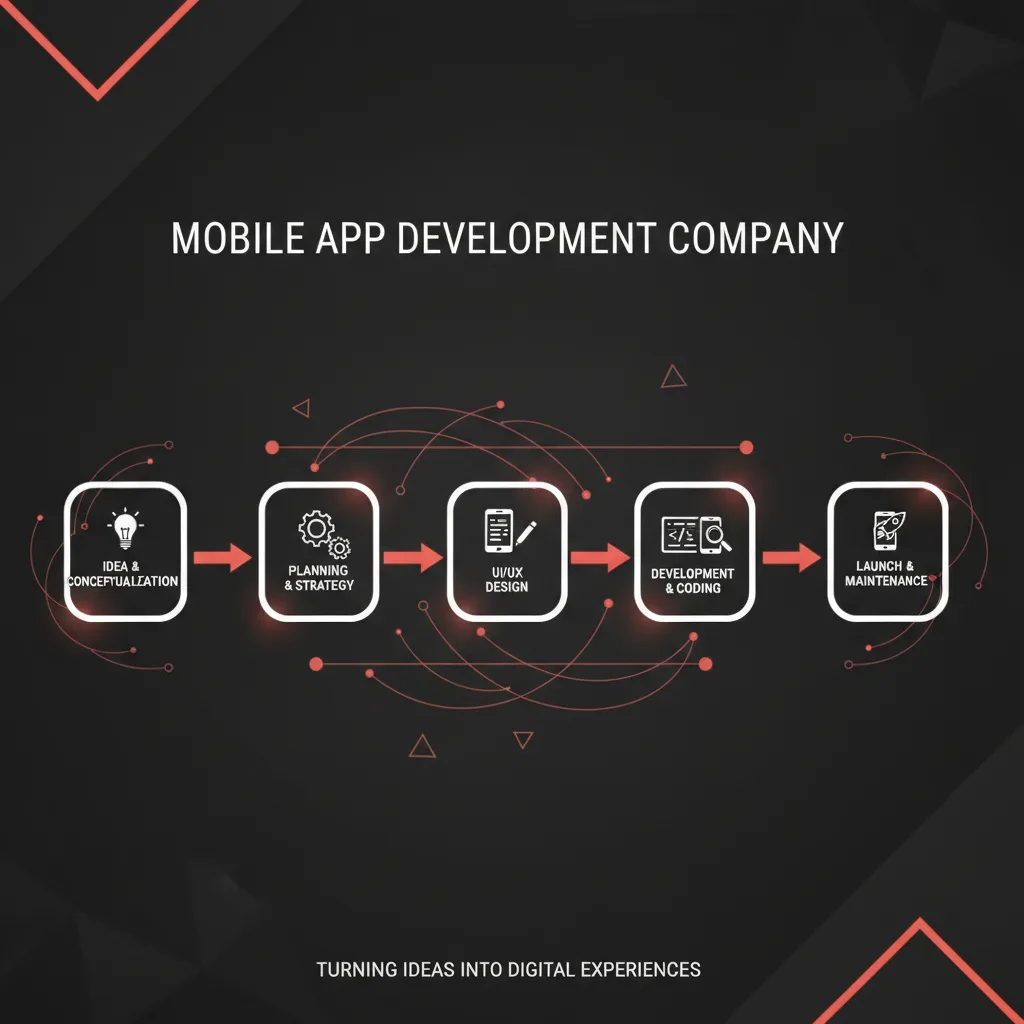
When founders and product teams ask what does a mobile app development company do, they're evaluating whether to hire a studio, recruit in-house, or work with freelancers. A mobile app development company delivers end-to-end services—discovery, UI/UX design, native iOS and Android development, backend engineering, quality assurance, app store deployment, and ongoing maintenance. Unlike individual developers who focus on coding, or in-house teams built from scratch, these studios bring coordinated cross-functional teams: product managers, designers, mobile developers, backend engineers, QA specialists, and DevOps professionals.
When founders and product teams ask what does a mobile app development company do, they're evaluating whether to hire a studio, recruit in-house, or work with freelancers. A mobile app development company delivers end-to-end services—discovery, UI/UX design, native iOS and Android development, backend engineering, quality assurance, app store deployment, and ongoing maintenance. Unlike individual developers who focus on coding, or in-house teams built from scratch, these studios bring coordinated cross-functional teams: product managers, designers, mobile developers, backend engineers, QA specialists, and DevOps professionals.
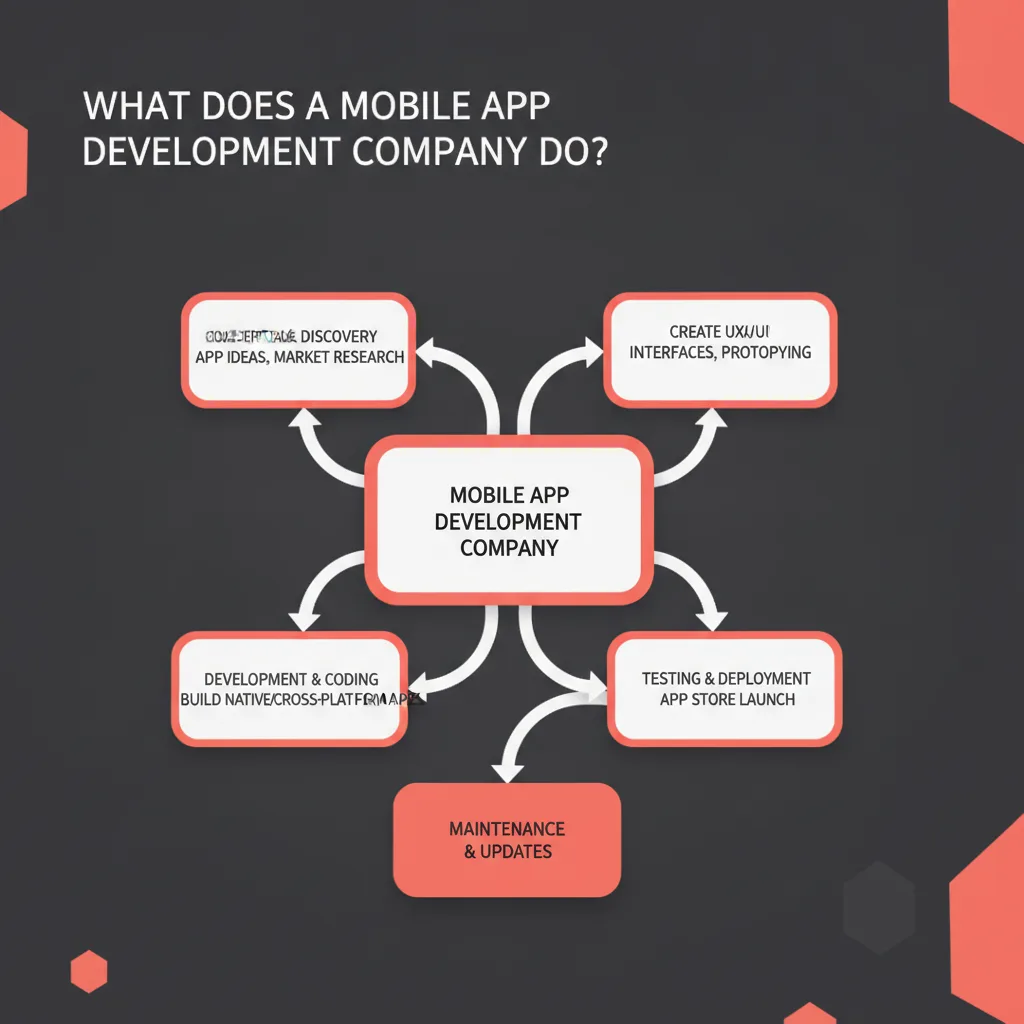
Mobile app development services produce diverse outputs. Consumer products like Fubble VPN require native Swift and Kotlin apps for WireGuard encryption performance. Industrial platforms like Bridge structural monitoring integrate custom STM32 hardware, BLE mesh networks, and AI sag analysis pipelines. Enterprise tools like Helios CRM combine mobile-responsive interfaces with real-time collaboration and AI assistants. LunexLab handles these projects end-to-end—embedded firmware, backend APIs, mobile apps, and AI integration—without third-party handoffs.
This guide explains what mobile app development companies do, the roles within these teams, the mobile application development process, and how to evaluate partners for your project. If you're comparing options, see our guide on choosing the best mobile app development agency.
Key Takeaways
- Mobile app development companies manage the full lifecycle: discovery, design, build, deployment, and maintenance—not just writing code.
- Cross-functional teams include product managers, UI/UX designers, iOS/Android developers, backend engineers, QA testers, and DevOps specialists working in coordinated sprints.
- Platform expertise spans native iOS (Swift) and Android (Kotlin), cross-platform frameworks (Flutter, React Native), backend APIs (Node.js, Python, Go), and cloud infrastructure (AWS, Google Cloud).
- Project outputs range from consumer apps (Fubble VPN native encryption) to industrial IoT (Bridge custom hardware + AI) and enterprise SaaS (Helios mobile-responsive CRM).
- Evaluation criteria: portfolio domain fit, platform expertise, post-launch support models, technical depth in backend/DevOps/hardware integration, and communication processes (Agile sprints, design reviews, QA cycles).
Core Services of a Mobile App Development Company
Discovery & Requirements Gathering
Before writing code, mobile app development companies conduct discovery: user research, technical feasibility analysis, feature prioritization, and stakeholder interviews. This phase defines the product roadmap, platform choices (native vs. cross-platform), integration requirements (third-party APIs, hardware, authentication), and success metrics. Discovery deliverables include feature specifications, user stories, wireframes, and technical architecture documents outlining backend, mobile SDKs, and third-party services.
For Helios CRM, discovery began with workflow interviews to map sales pipelines and AI assistant needs, ensuring the mobile-responsive design served field reps and managers equally. Discovery prevents scope creep, aligns stakeholders, and surfaces edge cases early—like offline-first sync for Bridge field nodes in tunnels with no cellular coverage.
UI/UX Design
Mobile app development teams employ dedicated UI/UX designers who create wireframes, interactive prototypes, and design systems aligned with platform-specific patterns: iOS Human Interface Guidelines and Material Design for Android. Designers iterate on user flows, conduct usability testing, and produce high-fidelity mockups and style guides. Design systems ensure consistency across iOS and Android apps, reduce handoff friction between designers and developers, and streamline future feature work.
For consumer products like Fubble VPN, clean onboarding flows and intuitive server selection screens improve retention. For industrial apps like Bridge, designers prioritize field usability: large tap targets for gloved hands, high-contrast displays for outdoor use, and offline-first workflows. Prototyping tools (Figma, Sketch, Adobe XD) enable rapid iteration before development begins, reducing rework and aligning stakeholders on the final vision.
Native & Cross-Platform Development
Mobile app development companies build apps using native languages—Swift or Objective-C for iOS, Kotlin or Java for Android—or cross-platform frameworks like Flutter and React Native. The choice depends on performance requirements, timeline, team expertise, and platform-specific features.
When to choose native development:
- Performance-critical apps (real-time encryption, VPN tunneling, gaming, AR/VR)
- Deep platform integration (HealthKit, Apple Pay, Android Enterprise APIs)
- Long-term maintenance with platform-specific optimizations
Fubble VPN uses native Swift and Kotlin to leverage WireGuard kernel modules and network extension APIs, ensuring low latency and battery efficiency.
When to choose cross-platform frameworks:
- Faster time-to-market with shared codebases (Flutter, React Native)
- Budget constraints or smaller teams
- Standard UI patterns without heavy platform-specific dependencies
Cross-platform doesn't mean "write once, run anywhere"—developers still implement platform-specific modules for payments, push notifications, and permissions. LunexLab evaluates trade-offs project by project, prioritizing technical fit over dogma.
Backend & API Development
Mobile apps rarely function standalone. Most require backend services for authentication, data storage, business logic, third-party integrations, and real-time sync. Mobile app development companies build RESTful APIs or GraphQL endpoints, design databases (PostgreSQL, MongoDB, Firebase), implement authentication (OAuth, JWT), and orchestrate cloud infrastructure (AWS, Google Cloud, Azure).Mileline courier payroll integrates CRM data with route sheets, calculating payout logic based on distance traveled. The backend handles payroll rules, tax compliance, and sync between mobile field apps and web dashboards. Backend teams also implement WebSocket or MQTT protocols for real-time features (chat, live tracking, collaboration), CDN strategies for media-heavy apps, and caching layers to reduce latency.
Hardware Integration (for IoT & Industrial Apps)
Some mobile app development companies—like LunexLab—specialize in hardware-integrated projects: BLE-connected medical devices, industrial sensors, robotics control, or smart home platforms. These projects require embedded firmware development (C/C++ on STM32, ESP32, Nordic nRF), communication protocols (BLE, Wi-Fi, GSM, LoRa), and mobile SDKs to interface with custom hardware.
Bridge structural monitoring illustrates this: custom field nodes (STM32 microcontrollers, BLE mesh, Wi-Fi, GSM modems, battery management, SD card store-and-forward) collect laser rangefinder data, transmit over mesh networks, and sync to cloud AI pipelines for sag analysis. The mobile app serves as a field diagnostic tool, visualizing sensor health and triggering manual sync when cellular coverage returns.
Not all app development agencies offer hardware expertise—evaluate this capability if your product involves IoT, wearables, or industrial automation.
Quality Assurance & Testing
Mobile app development teams employ QA engineers who write unit tests, integration tests, UI automation (XCTest, Espresso, Detox), and run manual device testing labs covering iOS and Android versions, screen sizes, and edge cases (poor network, low battery, interrupted flows). Beta rollout strategies (TestFlight for iOS, Google Play internal/closed testing) gather real-world feedback before public launch.
QA teams monitor crash analytics (Firebase Crashlytics, Sentry), identify regressions, and validate fixes across devices. For apps like Fubble VPN, QA validates encryption correctness, connection recovery, and kill-switch behavior under network failures—critical for security and user trust.
Deployment & App Store Optimization
Mobile app development companies handle App Store Connect and Google Play Console setup: provisioning profiles, signing certificates, app metadata (titles, descriptions, keywords), screenshots, privacy policies, and compliance checks (GDPR, CCPA, accessibility).
Deployment includes:
- Release management: Version tagging, staged rollouts (percentage-based releases), A/B testing metadata
- Compliance: Privacy manifests (iOS), data safety forms (Google Play), age ratings, in-app purchase disclosure
- Optimization: App Store Optimization (ASO) with keyword research, compelling screenshots, and localized descriptions
LunexLab submits apps for clients and manages ongoing updates, or trains client teams for self-service releases.
Maintenance & Updates
Post-launch, mobile app development services include bug fixes, OS compatibility updates (new iOS/Android versions), feature iterations, and analytics monitoring. Teams track user engagement (Mixpanel, Amplitude), crash rates, and performance metrics (cold start time, memory usage) to prioritize improvements.
Maintenance contracts typically cover:
- Monthly or quarterly OS updates
- Bug hotfixes
- Security patches
- Feature enhancements based on analytics and user feedback
For products like Fubble VPN, maintenance includes new server region rollouts, protocol updates (WireGuard version bumps), and subscription billing integrations with evolving App Store guidelines.
Roles & Team Structure in a Mobile App Development Company
Understanding what does a mobile app development company do requires understanding team structure. Studios coordinate specialists across disciplines, ensuring cohesive delivery from discovery through post-launch support.
Product Manager / Project Manager
Product managers define roadmaps, prioritize features, and communicate with clients or stakeholders. They write user stories, manage sprints (Agile/Scrum), and ensure delivery timelines align with business goals. Project managers coordinate cross-functional teams, track budgets, and surface blockers early to prevent delays.
Mobile Developers (iOS, Android, Cross-Platform)
iOS developers use Swift or Objective-C with Xcode, implementing UIKit or SwiftUI interfaces, integrating Apple SDKs (CoreData, CloudKit, HealthKit), and optimizing for performance. Android developers work in Kotlin or Java with Android Studio, implementing Material Design, Jetpack Compose, and Google Play Services. Cross-platform developers specialize in Flutter (Dart) or React Native (JavaScript/TypeScript), building shared business logic and platform-specific modules for native features.
Backend Engineers
Backend engineers design APIs, database schemas, authentication flows, and cloud infrastructure. They work in Node.js, Python (Django/Flask), Go, or Ruby, deploy on AWS (EC2, Lambda, RDS), Google Cloud (Cloud Run, Firestore), or Azure, and implement CI/CD pipelines for automated deployments.
UI/UX Designers
Designers create user flows, wireframes, high-fidelity mockups, and interactive prototypes. They conduct usability testing, maintain design systems (color palettes, typography, component libraries), and collaborate with developers on implementation fidelity.
QA Engineers & DevOps
QA engineers write test automation scripts, run regression suites, and manage beta testing programs. DevOps engineers set up CI/CD pipelines (GitHub Actions, GitLab CI, Jenkins), configure crash monitoring (Crashlytics, Sentry), and manage app signing, provisioning, and release automation.
When to Hire a Mobile App Development Company vs. Building In-House
| Scenario | Hire a Company | Build In-House |
|---|---|---|
| Speed to market | Faster—teams are pre-assembled, experienced | Slower—recruiting, onboarding, process setup |
| Specialized skills | Access to hardware integration, AI, DevOps on demand | Requires hiring niche experts (costly, slow) |
| Budget constraints | Predictable project pricing, no overhead | Salaries, benefits, office, retention costs |
| Long-term product roadmap | Good for MVP, risky for ongoing iteration | Better—retain knowledge, continuous iteration |
| Domain expertise | Studios bring cross-industry patterns | In-house teams build deep domain IP |
| Hybrid model (LunexLab approach) | We build client projects *and* own products (Fubble) | Some studios do both; evaluate case-by-case |
Hire a mobile app development company when:
- You need to launch an MVP quickly without recruiting a full team.
- Your project requires specialized skills (hardware integration, AI pipelines, complex backend).
- You lack in-house mobile expertise and want to de-risk execution.
Build in-house when:
- You have a long-term roadmap with continuous feature iteration.
- Deep domain knowledge and IP ownership are strategic advantages.
- You have budget and time to recruit, onboard, and retain talent.
Many companies adopt a hybrid approach: hire a studio for the initial build (de-risking launch), then transition to an in-house team for ongoing features, or retain the studio for maintenance and periodic enhancements.
Real-World Examples from LunexLab
Fubble VPN (Consumer Mobile Product)
Fubble VPN is a consumer privacy product with native iOS and Android apps built for WireGuard encryption performance. The project required:
- Native development: Swift (iOS) and Kotlin (Android) for low-latency VPN tunnel management and network extension APIs.
- Backend: Server orchestration, subscription billing (App Store, Google Play), and multi-region infrastructure.
- App Store compliance: Privacy manifests, data safety declarations, and ASO for competitive keywords.
LunexLab owns and operates Fubble, demonstrating the studio's capability to ship and maintain consumer-grade mobile products alongside client work.
Bridge Structural Monitoring (Industrial IoT + AI)
Bridge is an industrial platform for monitoring bridge and tunnel structural sag using custom hardware and AI analysis. The mobile component includes:
- Custom hardware: STM32-based field nodes with BLE mesh, Wi-Fi, GSM modems, battery management systems (BMS), SD card store-and-forward, and laser rangefinders.
- Mobile app: Field diagnostic tool for sensor health, manual sync, and offline-first data collection.
- AI pipeline: Cloud-based sag analysis using sensor data, alerting operators to structural anomalies.
This project showcases LunexLab's expertise in embedded firmware (C/C++ on STM32), BLE communication, and mobile apps integrated with industrial hardware—capabilities rare among app-only development shops.
Helios AI CRM (Enterprise SaaS)
Helios is a modern CRM with AI assistants for sales teams. The mobile-responsive web app includes:
- Real-time collaboration: WebSocket-based sync for multi-user workflows.
- AI integration: Natural language assistants for pipeline management and forecasting.
- Mobile-first design: Optimized for field reps on smartphones and tablets.
While Helios is primarily a web platform, the mobile-responsive design and API architecture illustrate LunexLab's full-stack capabilities—backend, frontend, and AI integration under one roof.
How to Choose a Mobile App Development Company
Portfolio & Case Studies
Review the company's portfolio for domain fit: consumer apps, enterprise tools, or industrial IoT. Look for case studies with technical depth—tech stacks, challenges solved, and measurable outcomes (launch timeline, user growth, performance metrics). LunexLab's work page showcases consumer (Fubble), industrial (Bridge), and enterprise (Helios, Mileline, ForgeKit) projects, demonstrating breadth across platforms and industries.
Platform Expertise
Evaluate native iOS and Android experience, cross-platform framework proficiency (Flutter, React Native), and backend capabilities (API design, cloud infrastructure, DevOps). If your app requires hardware integration, confirm embedded firmware and communication protocol expertise (BLE, Wi-Fi, LoRa). Ask for references on similar platforms or technical challenges.
Post-Launch Support
Clarify maintenance terms: bug fixes, OS updates, feature enhancements, analytics monitoring, and app store compliance. Some companies offer retainer-based support; others hand off code for client-managed updates. LunexLab provides ongoing maintenance for products like Fubble and offers retainer contracts for client projects.
Communication & Process
Understand the team's workflow: Agile sprints, design reviews, QA cycles, and client communication cadence (weekly demos, Slack channels, project management tools). Transparent processes reduce surprises and align expectations.
Technical Depth
Assess capabilities beyond mobile: backend engineering, DevOps, AI/ML integration, and hardware expertise if needed. Studios with full-stack teams reduce coordination overhead and deliver cohesive products. LunexLab's Bridge project required mobile, firmware, backend, and AI expertise—handled in-house without third-party vendors.
Frequently Asked Questions
What is the difference between a mobile app developer and a mobile app development company?
A mobile app developer is an individual contributor—typically a coder specializing in iOS (Swift), Android (Kotlin), or cross-platform frameworks (Flutter, React Native). Developers implement features, fix bugs, and optimize performance.
A mobile app development company is a cross-functional team delivering end-to-end services: product management, UI/UX design, mobile and backend development, QA testing, DevOps, and post-launch maintenance. Companies handle the full lifecycle from discovery through deployment and ongoing updates.
Freelance developers offer flexibility and lower costs but lack the team depth for complex projects (backend, hardware, design). Companies provide coordinated teams, accountability, and comprehensive service—ideal for MVPs, enterprise platforms, or industrial apps.
How long does it take a mobile app development company to build an app?
Timelines vary by complexity:
- Simple MVP (basic UI, minimal backend, single platform): 8–12 weeks
- Mid-complexity (backend APIs, authentication, payments, iOS + Android): 3–6 months
- Complex (hardware integration, AI pipelines, multi-platform, enterprise features): 6–12+ months
Fubble VPN's initial iOS and Android apps took ~4 months (native development, WireGuard integration, backend setup). Bridge's hardware + mobile system required ~9 months due to custom STM32 firmware, BLE mesh, and AI pipeline development. Timelines depend on feature scope, platform choices (native vs. cross-platform), team size, and client responsiveness during design and QA reviews.
Do mobile app development companies handle app store submissions?
Yes, most mobile app development services include App Store Connect (iOS) and Google Play Console (Android) setup, metadata optimization, compliance checks (privacy policies, data safety forms), and initial submission. Companies manage provisioning profiles, signing certificates, screenshots, and release notes.
Ongoing updates may be client-managed (if you have in-house teams) or handled by the development company under a maintenance contract. LunexLab manages Fubble's app store presence and offers submission services for client projects.
Can a mobile app development company integrate hardware or IoT devices?
It depends on the company's expertise. Many app-only studios lack embedded firmware or hardware integration capabilities. Studios like LunexLab specialize in IoT and industrial projects, delivering:
- Embedded firmware (C/C++ on STM32, ESP32, Nordic nRF)
- Communication protocols (BLE, Wi-Fi, GSM, LoRa)
- Mobile SDKs for hardware interaction
- Store-and-forward, offline-first sync, and mesh networking
The Bridge project illustrates this: custom STM32 nodes with BLE mesh, laser rangefinders, and mobile diagnostic apps—end-to-end from circuit design through cloud AI pipelines. If your app requires hardware integration, verify the company's embedded and firmware experience before committing.
What platforms do mobile app development companies support?
Most companies support:
- iOS: Swift, Objective-C, Xcode, Apple SDKs (UIKit, SwiftUI, CoreData, HealthKit)
- Android: Kotlin, Java, Android Studio, Material Design, Jetpack Compose
- Cross-platform: Flutter (Dart), React Native (JavaScript/TypeScript)
- Backend: Node.js, Python, Go, Ruby, cloud platforms (AWS, Google Cloud, Azure)
Some studios (like LunexLab) also support:
- Embedded firmware: C/C++ on STM32, ESP32, Raspberry Pi
- Hardware protocols: BLE, Wi-Fi, GSM, LoRa, MQTT
- AI/ML: TensorFlow, PyTorch, cloud AI services (AWS SageMaker, Google Vertex AI)
Confirm platform support aligns with your project needs—native performance, cross-platform speed, or hardware integration.
Conclusion
Mobile app development companies deliver comprehensive services spanning discovery, UI/UX design, native and cross-platform development, backend engineering, quality assurance, deployment, and ongoing maintenance. Teams include product managers, designers, mobile developers (iOS, Android, Flutter), backend engineers, QA specialists, and DevOps professionals—coordinated to ship cohesive, production-ready apps.
LunexLab builds consumer mobile products like Fubble VPN, industrial IoT platforms like Bridge (custom hardware + AI), and enterprise tools like Helios CRM. Our team handles embedded firmware, backend APIs, mobile apps, and AI pipelines—end-to-end, in-house, without third-party handoffs.
Ready to scope your mobile app project? Explore our services and work, or contact us to discuss your requirements. Whether you need a consumer app, industrial platform, or enterprise tool, LunexLab delivers practical, production-grade solutions.
For more insights on evaluating app development partners, see our guide on the best mobile app development agency. If you're exploring low-code alternatives, read our reviews of Google AI Studio and AWS App Studio to understand how AI-assisted platforms compare to custom development.