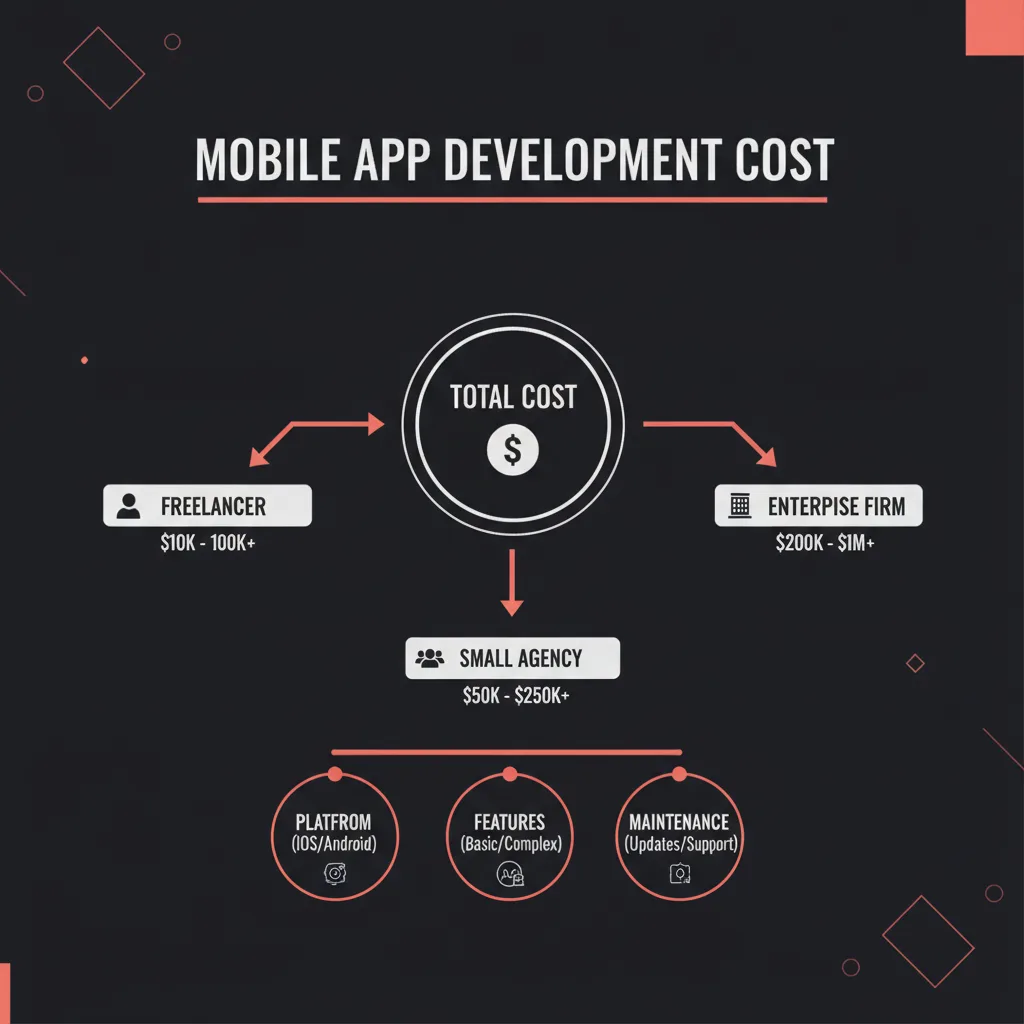
If you're planning to build a mobile app, the first question is almost always about cost. How much does it cost to pay someone to build a mobile app? The answer depends on who builds it, what it does, and how polished it needs to be—but expect a range from $10,000 to $300,000+ for professional work.
If you're planning to build a mobile app, the first question is almost always about cost. How much does it cost to pay someone to build a mobile app? The answer depends on who builds it, what it does, and how polished it needs to be—but expect a range from $10,000 to $300,000+ for professional work.
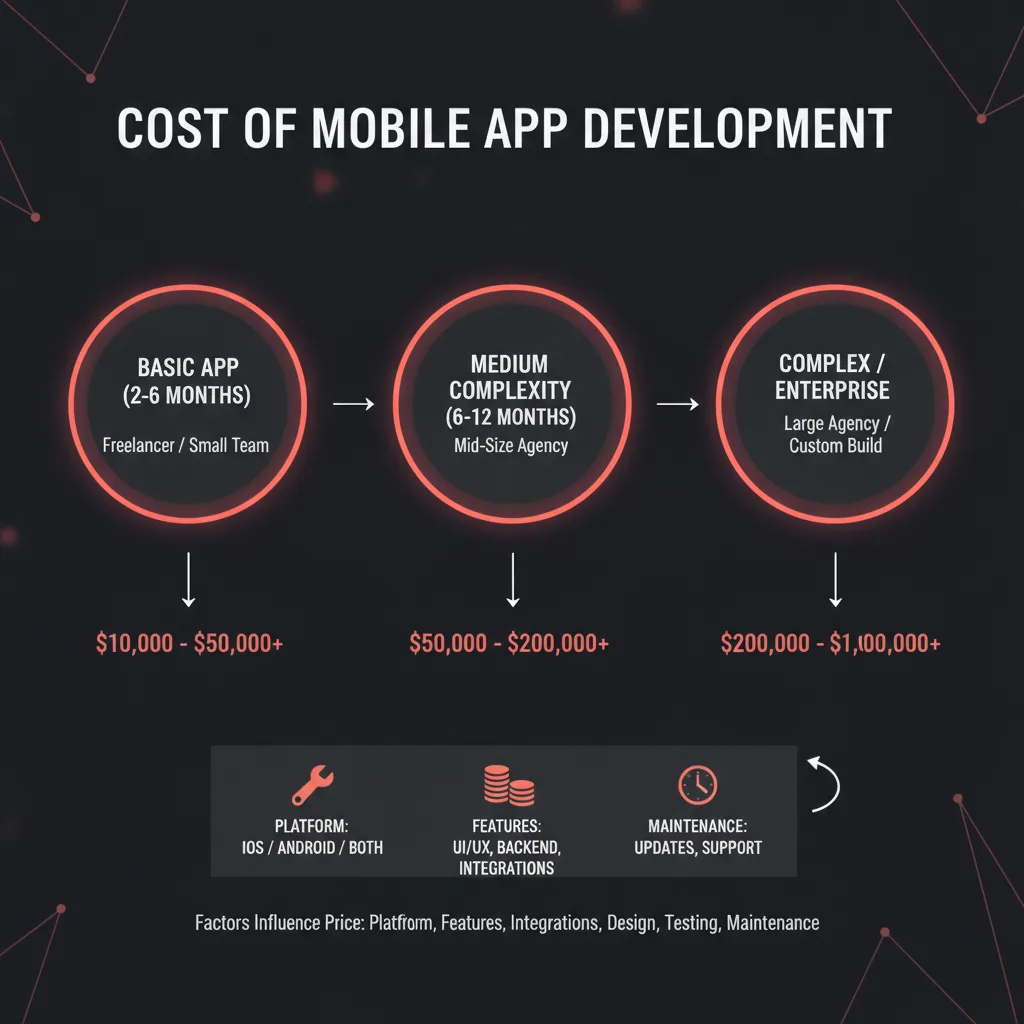
At the low end, a freelance developer might charge $10,000–$25,000 for a simple CRUD app with basic features. At the high end, a specialized US agency building a fintech app, healthcare platform, or industrial IoT solution can run $150,000–$300,000 or more. Most mid-tier consumer or business apps—like the kind LunexLab ships—fall in the $40,000–$120,000 range, depending on platform, backend complexity, and hardware integrations.
This guide breaks down hourly rates, project phases, real-world examples (including our own Fubble VPN and industrial hardware projects), and how to choose between a freelancer, agency, or in-house team. By the end, you'll have a practical framework for budgeting your mobile app project in 2025.
Key Takeaways
- Typical cost range: $10,000–$300,000+ depending on scope, team structure, and feature complexity.
- Freelancer rates: $20–$50/hr (Upwork, Fiverr); project risk and management overhead are yours to own.
- US agency rates: $100–$200/hr for general mobile apps; $200–$400/hr for fintech, healthcare, or hardware-integrated solutions.
- Maintenance budget: Plan for 15–20% of the initial build cost annually for updates, hosting, and compliance.
- Real examples: LunexLab has shipped Fubble VPN (consumer VPN, iOS/Android, $50k–$80k) and Bridge (industrial field nodes with BLE, GSM, mesh radios, and AI analysis, $120k+).
---
Key Factors That Determine Mobile App Development Cost
The cost to build a mobile app isn't a fixed number—it's shaped by six core factors.
App Complexity
A simple app that reads data from an API and displays it in a list view costs far less than a real-time AI assistant or a logistics platform with route optimization. Complexity layers include:
- Simple CRUD apps: User login, profile, basic forms. Think note-taking apps or basic directory tools.
- Moderate complexity: Payment processing, third-party integrations (Stripe, Twilio), push notifications, offline sync.
- High complexity: Real-time data (live GPS tracking, chat), AI/ML models, computer vision, custom backend with microservices.
- Industrial/hardware integration: BLE device pairing, GSM telemetry, mesh networking, sensor fusion. Our Bridge project required STM32 firmware, BLE commissioning, and cellular fallback for field nodes—well beyond typical app work.
Platform Choice
Building for one platform (iOS or Android) is cheaper than building for both. Your options:
- iOS only or Android only: Single codebase, single QA surface. Budget savings of 30–40% vs dual-platform.
- Cross-platform (React Native, Flutter): Write once, deploy to both. Saves 20–30% vs two native codebases, but may sacrifice performance or access to bleeding-edge OS features.
- Native (Swift + Kotlin): Maximum performance and platform fidelity, but doubles dev and QA time.
Most startups launch on iOS first (higher revenue per user in the US), then add Android if traction justifies it.
Design Requirements
UI/UX design can account for 15–25% of your total budget. Choices include:
- Stock UI components: Use default platform widgets (Material Design on Android, Human Interface Guidelines on iOS). Minimal cost.
- Custom branding: Bespoke iconography, color systems, animations. Adds 40–80 hours of design work.
- Motion design & micro-interactions: Elevates user experience but requires iteration cycles with developers.
For Fubble VPN, we balanced brand identity with platform conventions—custom illustrations and color theming, but native navigation patterns to keep QA manageable.
Backend & Integrations
Your app likely needs a backend for user authentication, data storage, or business logic. Costs vary:
- Backend-as-a-Service (Firebase, Supabase): Low upfront cost, higher scaling fees. Good for MVPs.
- Custom backend (Node.js, Python/Django, Go): More control, better for complex workflows. Adds $15k–$50k depending on API surface.
- Third-party integrations: Stripe for payments, Twilio for SMS, Mapbox for maps. Each integration adds 20–40 hours.
- Hardware APIs: BLE device pairing, GSM modem control, CAN bus integration. Rare skillset, premium rates.
Team Location & Structure
Where your developers live dramatically affects hourly rates:
- US-based freelancers: $40–$80/hr
- Offshore freelancers (Eastern Europe, India): $20–$40/hr
- US agencies: $100–$200/hr
- Specialized agencies (fintech, healthcare, IoT): $200–$400/hr
Cheaper doesn't always save money—project delays, communication overhead, and rework can erase rate differences. Agencies bundle project management, QA, and design into their rates; freelancers often bill only for coding.
Timeline & Team Size
A six-month build with two developers costs less than a three-month sprint with four. Rush projects incur premium rates and higher bug risk. Plan for:
- MVP (3–4 months): Lean feature set, one platform, BaaS backend.
- Full v1 (6–9 months): Both platforms, custom backend, polished UX.
- Enterprise/industrial (9–18 months): Compliance (HIPAA, SOC 2), hardware integrations, field testing.
---
Hourly Rates: Freelancers vs Agencies vs In-House
The cost to hire app developer talent varies by engagement model. Here's a breakdown of typical hourly rates and what you get for them.
Freelance Developers
Hourly rate: $20–$50/hr (global platforms like Upwork, Toptal, Fiverr).
#### What You Get
- Direct access to the developer writing your code.
- Flexibility to hire for specific tasks (UI work, API integration).
- Lower overhead—no account managers or design teams.
#### What You Manage
- Project scope, timeline, and quality assurance.
- Communication across time zones if hiring offshore.
- Risk of abandonment or inconsistent availability.
Best for: Simple apps, MVPs, or filling a specific skill gap when you have in-house product management.
Real-world cost example: A 500-hour project at $40/hr = $20,000. Add 10–20% for scope creep and bug fixes.
US-Based Agencies
Hourly rate: $100–$200/hr for general mobile app work; $200–$400/hr for fintech, healthcare, or industrial applications.
#### What You Get
- Dedicated team (PM, designer, 1–3 developers, QA).
- Established workflows, version control, code reviews.
- Legal protections (contracts, IP assignment, NDAs).
- Post-launch support and maintenance plans.
#### What You Manage
- Strategic direction and user feedback.
- Approval of designs and sprint deliverables.
Best for: Funded startups, product teams that need speed and reliability, or projects requiring specialized skills (AI, hardware integration, compliance).
Real-world cost example: A 500-hour project at $150/hr = $75,000. Agencies often quote fixed-price for scope clarity; at LunexLab, we provide project scoping and fixed estimates after a discovery phase.
In-House Developers
Annual cost: $80,000–$140,000 salary + 25–35% benefits and payroll taxes = $100,000–$190,000 fully loaded.
#### What You Get
- Full-time dedication to your roadmap.
- Deep product and domain knowledge.
- Long-term asset for ongoing feature development.
#### What You Manage
- Hiring, onboarding, equipment, benefits.
- Single point of failure if developer leaves mid-project.
- Less breadth (one dev rarely covers iOS + Android + backend + design).
Best for: Post-product-market-fit companies with 12+ months of feature backlog.
Real-world cost example: Hiring one senior mobile dev at $120k/year for a six-month build = $60,000 (salary only). Add recruiter fees ($20k–$30k) and benefits.
Cost Comparison Table
| Team Type | Hourly Rate | 500-Hour Project Cost | Pros | Cons |
|---|---|---|---|---|
| Freelancer (offshore) | $20–$40/hr | $10,000–$20,000 | Lowest cost, flexible engagement | High management overhead, variable quality |
| Freelancer (US) | $40–$80/hr | $20,000–$40,000 | Better communication, mid-tier cost | Still requires PM on your side |
| US Agency (general) | $100–$200/hr | $50,000–$100,000 | Full team, proven process | Higher rate, less control over individuals |
| US Agency (specialized) | $200–$400/hr | $100,000–$200,000 | Expert domain knowledge (fintech, IoT) | Premium pricing |
| In-house (6 months) | ~$120k/yr | $60,000 (salary only) | Long-term asset, deep integration | Recruiting delay, benefits overhead |
---
Project Cost Breakdown by Phase
Understanding how agencies and freelancers allocate hours across project phases helps you spot underpriced proposals (which usually skip QA or design) and justify premium rates.
Typical Phase Allocation
| Phase | % of Budget | Hours (500-hr project) | What Happens |
|---|---|---|---|
| Discovery & Planning | 10–15% | 50–75 hrs | Requirements gathering, technical feasibility, architecture design, wireframes |
| UI/UX Design | 15–25% | 75–125 hrs | Visual design, interaction prototypes, design system, branding |
| Development | 40–55% | 200–275 hrs | Frontend (iOS/Android), backend APIs, integrations, admin dashboards |
| QA & Testing | 10–15% | 50–75 hrs | Manual testing, automated tests, regression, device compatibility |
| Launch & Post-Launch | 5–10% | 25–50 hrs | App store submission, release monitoring, hotfixes, user onboarding tweaks |
Discovery & Planning
This phase involves requirements gathering, technical feasibility assessment, architecture design, and wireframes. Skipping discovery leads to scope creep and rework—budget 10–15% upfront to define the project correctly.
UI/UX Design
Visual design, interaction prototypes, design systems, and branding happen here. A well-designed app reduces support tickets and improves retention, justifying the 15–25% budget allocation.
Development
Frontend (iOS/Android), backend APIs, third-party integrations, and admin dashboards consume the bulk of your budget. Expect 40–55% of total project hours here.
QA & Testing
Manual testing, automated tests, regression testing, and device compatibility checks prevent post-launch fires. Underfunding QA saves 10% upfront but often doubles bug-fix costs post-launch.
Launch & Post-Launch
App store submission, release monitoring, hotfixes, and user onboarding tweaks ensure a smooth debut. Budget 5–10% for this phase.
Ongoing Maintenance
After launch, budget 15–20% of the initial build cost per year for:
- OS updates (iOS/Android release annually; APIs deprecate).
- Bug fixes and performance optimization.
- Backend hosting, database scaling, CDN fees.
- Security patches and third-party SDK updates.
For Fubble VPN, annual maintenance runs ~$10k–$15k (server infrastructure, WireGuard updates, app store compliance tweaks).
---
Real-World Mobile App Cost Examples
Abstract ranges are useful, but real projects anchor expectations. Here are five tiers from simple to industrial-grade.
Simple CRUD App
Example: Recipe tracker, personal journal, basic e-commerce browser.
Features:
- User login (email/password or OAuth).
- List views with search/filter.
- Form-based data entry.
- Cloud sync (Firebase or similar BaaS).
Team: Solo freelancer or small offshore team.
Timeline: 2–3 months.
Cost: $10,000–$25,000.
Fubble VPN (Consumer VPN, iOS + Android)
Case study: Fubble VPN is LunexLab's flagship consumer product—a privacy-focused VPN with server selection, in-app purchase subscriptions, and cross-platform support.
Features:
- Native iOS (Swift) and Android (Kotlin) apps.
- WireGuard tunnel integration.
- In-app purchase (StoreKit, Google Play Billing).
- Backend API for server orchestration and user management.
- Custom UI with animated connection states.
Team: LunexLab (PM, 2 developers, designer, QA).
Timeline: 5 months (MVP); ongoing feature releases.
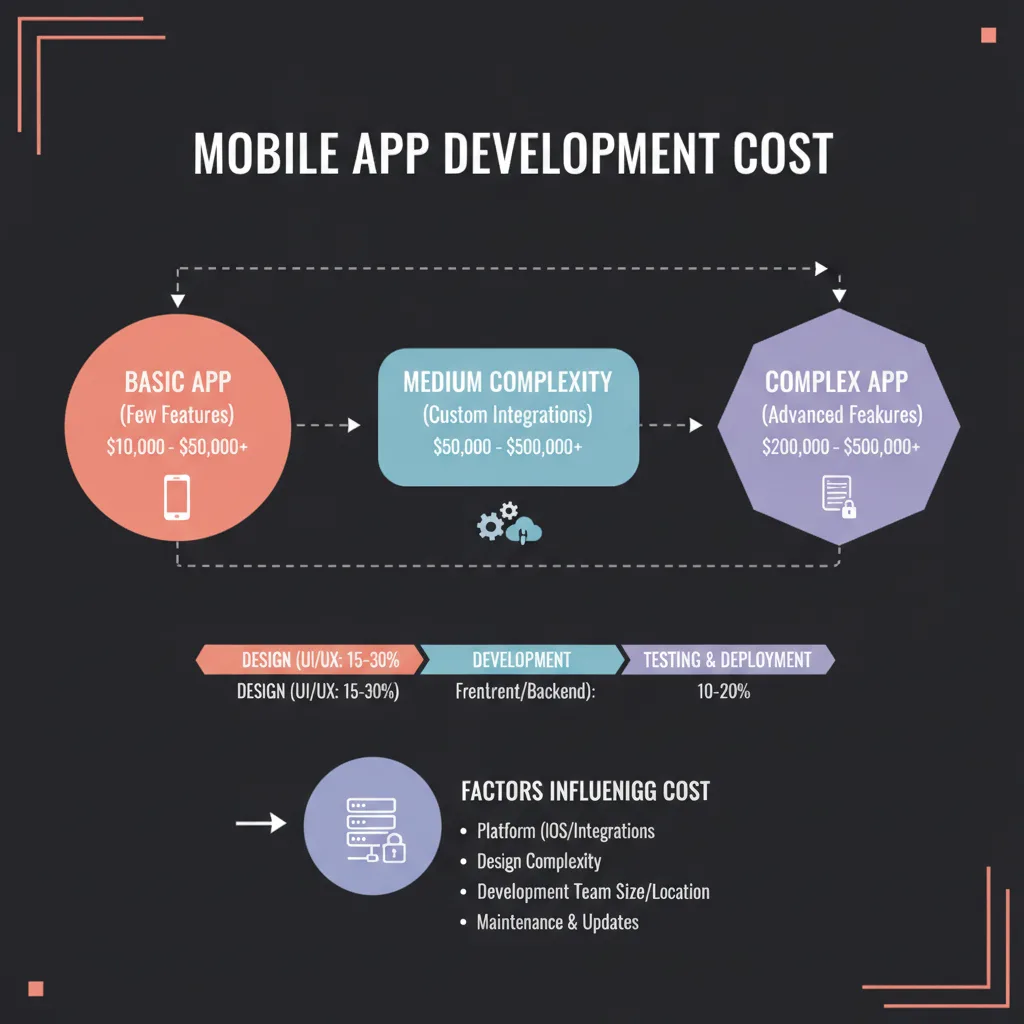
Cost: $50,000–$80,000 (initial build). Annual ops/maintenance: $10k–$15k.
Lessons:
- Cross-platform added 30% cost vs iOS-only.
- In-app purchase compliance (App Store Review, subscription edge cases) took longer than expected.
- Server infrastructure (VPN exit nodes, monitoring) is an ongoing line item.
Marketplace or Social App
Example: Two-sided marketplace (buyers + sellers), community platform, booking app.
Features:
- User profiles with ratings/reviews.
- Real-time messaging (chat or notifications).
- Payment processing (Stripe Connect for marketplace splits).
- Moderation tools or admin dashboard.
- Push notifications and email campaigns.
Team: Mid-tier US agency or senior freelancer with backend expertise.
Timeline: 6–9 months.
Cost: $50,000–$150,000.
Bridge (Industrial Hardware + AI)
Case study: Bridge is an industrial structural monitoring system with custom field nodes and AI-powered sag analysis.
Features:
- Custom hardware: STM32 microcontrollers, BLE commissioning, Wi-Fi, GSM cellular, BMS (battery management), SD store-and-forward, mesh radios, laser rangefinders.
- Mobile app (iOS/Android) for field commissioning and live data visualization.
- Backend: store-and-forward telemetry, AI analysis (bridge sag detection), alerting.
- Offline-first design (nodes cache data when cellular drops).
Team: LunexLab (firmware engineer, mobile dev, backend dev, ML engineer, PM).
Timeline: 9 months (v1 deployment).
Cost: $120,000+ (hardware NRE, firmware, mobile app, backend, field testing).
Lessons:
- Hardware integration (BLE pairing, GSM modem drivers) added 40% vs pure-software app.
- Regulatory testing (FCC for radio) and field deployment logistics aren't in typical app budgets.
- AI model training required domain expertise (structural engineering) beyond standard ML.
Enterprise or Fintech App
Example: HIPAA-compliant telehealth platform, banking app, insurance claims processing.
Features:
- Multi-factor authentication, biometric login.
- End-to-end encryption (FIPS 140-2 compliance).
- Audit logging and data retention policies.
- Third-party integrations (EHR systems, payment processors).
- Accessibility compliance (WCAG 2.1).
Team: Specialized agency with compliance and security expertise.
Timeline: 9–18 months (includes audits and certifications).
Cost: $100,000–$300,000+.
---
How to Choose Between a Freelancer, Agency, or In-House Team
The best engagement model depends on your budget, timeline, and risk tolerance. Here's a decision framework.
Choose a Freelancer If:
- You have a tight budget ($10k–$30k) and can manage project scope yourself.
- Your app is simple (CRUD, single platform, no custom backend).
- You're technical and can review code, write specs, and handle QA.
- Timeline is flexible—freelancers often juggle multiple clients.
Red flags: Avoid freelancers who won't sign IP assignment agreements, have no portfolio, or quote suspiciously low rates for complex features.
Choose an Agency If:
- You need speed and reliability—agencies have bench depth to swap in resources if someone is sick or leaves.
- Your app requires specialized skills (AI/ML, hardware integration, compliance).
- You lack in-house technical leadership and need a team to own design, dev, and QA.
- Your budget is $40k+ and you value predictable delivery over hourly cost savings.
Red flags: Agencies that won't share case studies, refuse fixed-price proposals, or outsource core work to untested contractors.
At LunexLab, we focus on non-trivial apps—projects where a $5,000 no-code template won't cut it. Our case studies (Fubble VPN, Bridge, Helios CRM, Mileline payroll) demonstrate experience shipping consumer and industrial products. We offer project scoping and fixed-price proposals after discovery; contact us for an estimate.
Choose In-House If:
- You have 12+ months of feature backlog and product-market fit.
- You're post-Series A with budget for $150k+ annual fully-loaded engineer cost.
- Your product requires deep domain integration (e.g., proprietary algorithms, regulatory knowledge).
- You can recruit and retain talent—mobile devs are competitive hires in 2025.
Red flags: Hiring in-house before validating product-market fit ties up capital in salary when you should be iterating fast with external teams.
---
How to Reduce Mobile App Development Costs Without Sacrificing Quality
Cutting cost doesn't mean cutting corners. Here are six strategies to stay on budget.
Start with an MVP Scope
Launch with one hero feature, not ten mediocre ones. Validate demand before building advanced features. Fubble VPN's MVP was iOS-only with three server locations—we added Android and 20+ servers after user traction.
Use Cross-Platform Frameworks
React Native or Flutter let you share 70–80% of code between iOS and Android. Savings: 20–30% vs two native codebases. Trade-off: slightly lower performance for compute-heavy apps (games, video editing).
Prioritize One Platform First
Launch iOS or Android, not both. Gather feedback, fix bugs, then port. Savings: 30–40% vs simultaneous dual-platform build.
Leverage Existing Design Systems
Material Design (Android) and Human Interface Guidelines (iOS) are free, tested, and accessible. Custom UI is beautiful but expensive—reserve it for brand-critical screens.
Plan for Phased Releases
Ship v1.0 with core features, then iterate. Don't bundle "nice-to-have" features (dark mode, social login, gamification) into your initial contract—add them in v1.1 or v1.2 based on user feedback.
Consider No-Code for True MVPs
If your app is a form-over-database (directory, booking tool, simple marketplace), tools like Bubble, Adalo, or Glide can get you to market for $5k–$15k. When you need custom logic, hardware integration, or offline-first sync, graduate to a custom build. See our guide on the best free AI app builder for a comparison of no-code vs custom development paths.
When no-code fails: Any app requiring BLE device pairing, custom ML models, real-time GPS tracking, or CRM integrations typically needs custom code. Our Bridge project—with STM32 firmware and mesh radios—would be impossible on a no-code platform.
---
Hidden Costs to Budget For
Even the best project estimate misses line items that surface post-launch. Plan for these hidden costs.
App Store Fees
- Apple Developer Program: $99/year (required to publish on App Store).
- Google Play Console: $25 one-time fee.
Third-Party Services
- Analytics: Mixpanel, Amplitude (free tiers exist; paid plans start at $25/month).
- Push notifications: OneSignal, Firebase Cloud Messaging (free up to a threshold; $50–$200/month for scale).
- Backend hosting: AWS, Google Cloud, or DigitalOcean ($50–$500/month depending on traffic).
- CDN for assets: Cloudflare, Fastly ($20–$200/month).
For Fubble VPN, server infrastructure (VPN exit nodes across 20+ cities) runs $800–$1,200/month—well above typical app hosting.
Compliance & Security Audits
- HIPAA compliance: $10k–$30k for initial BAA, audit, and infrastructure hardening.
- SOC 2 Type II: $25k–$75k (required for enterprise B2B SaaS).
- Penetration testing: $5k–$20k for third-party security audit.
Post-Launch Iteration & Bug Fixes
Budget 10–15% of build cost for the first three months post-launch. User-reported edge cases, OS updates, and App Store review rejections always surface.
Marketing & User Acquisition
Your app won't market itself. Budget for:
- App Store Optimization (ASO): $2k–$10k for keyword research, screenshots, A/B testing.
- Paid ads: $500–$5,000/month for Facebook, Google, or Apple Search Ads.
- PR & influencer outreach: $5k–$25k for launch campaign.
---
FAQ
How much does it cost to hire a mobile app developer per hour?
Freelance mobile app developers charge $20–$80/hr depending on location and experience. Offshore developers (India, Eastern Europe) typically charge $20–$40/hr; US-based freelancers charge $40–$80/hr. Agencies bundle developers, designers, and PMs at $100–$200/hr (general work) or $200–$400/hr (fintech, healthcare, IoT). In-house developers cost $80k–$140k/year salary plus 25–35% benefits.
What's the average cost to build a simple mobile app?
A simple mobile app (user login, list views, basic forms, cloud sync) costs $10,000–$25,000 when built by a freelancer or offshore team. This assumes one platform (iOS or Android), a Backend-as-a-Service like Firebase, and minimal custom design. Cross-platform or dual-native builds add 30–50% to cost.
Is it cheaper to hire a freelancer or an agency?
Freelancers charge lower hourly rates ($20–$80/hr vs $100–$200/hr for agencies), but you absorb project management, QA, and design costs. For simple apps with clear specs, freelancers save 30–50%. For complex apps (AI, hardware, compliance), agencies de-risk delivery—missed deadlines or rework often erase freelancer savings. Budget, timeline, and your own technical capacity determine the best choice.
How long does it take to build a mobile app?
An MVP takes 2–4 months with a small team (one developer, part-time designer). A polished v1.0 with both iOS and Android, custom backend, and refined UX takes 6–9 months. Enterprise or industrial apps requiring compliance (HIPAA, SOC 2) or hardware integrations take 9–18 months. Freelancers working part-time extend timelines by 50–100% vs dedicated agency teams.
What's the cheapest way to build a mobile app?
No-code platforms (Bubble, Adalo, Glide) offer the lowest upfront cost—$5,000–$15,000 for simple apps—but limit customization and scalability. For apps requiring custom logic, offline sync, hardware integrations, or real-time data, a freelance developer at $20–$40/hr (offshore) is the cheapest *custom* route. However, cheaper often means slower delivery and higher rework risk. See our breakdown on free AI app builder tools for more on when no-code makes sense.
---
Conclusion & Next Steps
So, how much does it cost to pay someone to build a mobile app? The honest answer is $10,000 to $300,000+, shaped by who builds it (freelancer, agency, in-house), what it does (CRUD vs AI vs hardware integration), and how polished it needs to be (MVP vs enterprise-grade).
Quick reference:
- Simple app, freelancer: $10k–$25k
- Consumer app, agency (like Fubble VPN): $50k–$80k
- Marketplace or social app: $50k–$150k
- Industrial or hardware-integrated app (like Bridge): $120k+
- Fintech or healthcare app: $100k–$300k+
At LunexLab, we build non-trivial mobile apps—projects where a $5k template won't cut it. We've shipped Fubble VPN (cross-platform consumer VPN), Bridge (industrial field nodes with BLE, GSM, and AI), and CRM platforms like Helios and Mileline. Our process: scoping workshop, fixed-price proposal, iterative delivery, post-launch support.
Ready to budget your project? Contact LunexLab for a project estimate. We'll review your feature list, recommend a platform strategy, and deliver a transparent cost breakdown—no black-box hourly estimates.
For more on choosing the right development partner, see our guide on the best mobile app development agency. If you're evaluating no-code first, read can AI Studio build an app? to understand where automation ends and custom development begins.