
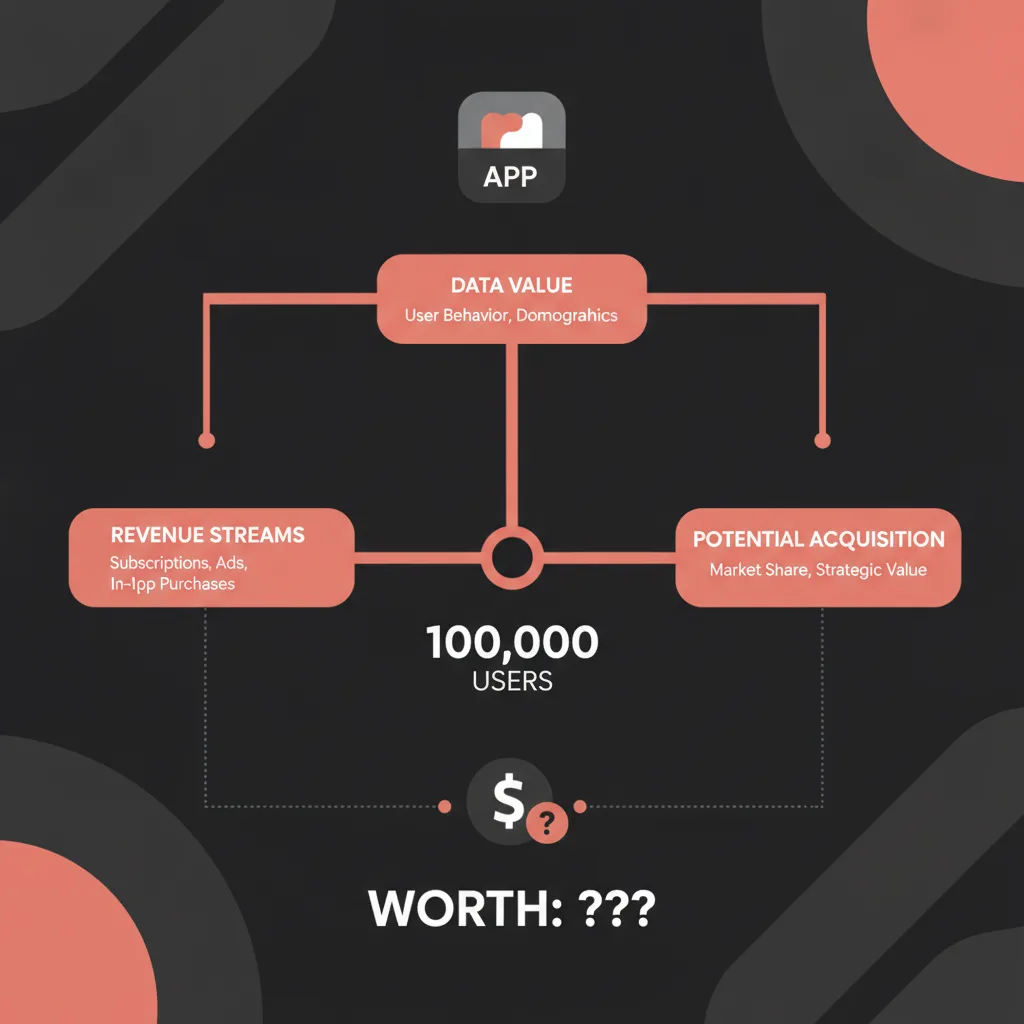
Reaching 100,000 users is a significant milestone for any mobile app, but the question founders and product teams immediately ask is: how much is an app with 100,000 users worth? The answer varies dramatically — from $100,000 to well over $10 million — depending on your revenue model, user engagement, growth trajectory, and market vertical. An app with 100,000 monthly active users generating $50,000 in monthly recurring revenue will command a vastly different valuation than one with the same user count but relying solely on ad impressions.
At LunexLab, we've helped founders scale products from prototype to tens of thousands of active users, including our own consumer product Fubble VPN. This guide breaks down how app valuation works at the 100k-user mark, what buyers look for, and what you can realistically expect when it's time to scale or exit.
Key Takeaways:
- Valuation is a function of revenue, engagement, defensibility, and buyer intent — not just user count
- Revenue multiples range from 3–10× annual recurring revenue (ARR) for SaaS apps, 0.5–2× for ad-based models
- User count alone is insufficient; you need monthly active users (MAU), daily active users (DAU), churn rate, and lifetime value (LTV)
- Infrastructure costs at 100,000-user scale directly reduce net value and affect acquisition multiples
- Strategic acquirers pay more for user base overlap and technical assets; financial buyers focus on cash flow and margin
---
Valuation Methodologies for Apps with 100,000 Users
App valuation isn't a single formula. Buyers and advisors use multiple frameworks depending on your business model, stage, and growth profile. Here are the three primary methods used to value apps at the 100k-user tier.
Revenue-Based Valuation (ARR/MRR Multiples)
For subscription and SaaS apps, revenue multiples are the industry standard. Acquirers typically pay 3–10× your annual recurring revenue (ARR), with the multiple determined by growth rate, churn, and market position. A fast-growing app with strong unit economics can command the high end of this range; a mature app with flat growth will sit at the lower end.
Example: If your app generates $50,000 in monthly recurring revenue (MRR), that's $600,000 ARR. At a 5× multiple, your valuation would be $3 million. If you can demonstrate 10% month-over-month growth and sub-5% monthly churn, you might push that multiple to 7–8×, yielding $4.2–4.8 million.
Freemium apps follow similar logic, but your conversion rate from free to paid users becomes critical. If only 2% of your 100,000 users convert to a $10/month subscription, you're generating $20,000 MRR ($240,000 ARR). At a 4× multiple, that's $960,000. Improving conversion to 5% triples your revenue and valuation proportionally.
User-Based Valuation (Cost per User)
When revenue is minimal or early-stage, acquirers often use a per-user benchmark. The range is wide — $10 to $100+ per monthly active user — depending on vertical and engagement quality.
Typical ranges by category:
- Social and entertainment apps: $20–50 per MAU
- B2B and enterprise tools: $50–200 per MAU (or per seat)
- Ad-supported consumer apps: $5–20 per MAU
- Fintech and marketplace apps: $50–150 per MAU
An app with 100,000 MAU in the social space might be valued at $2–5 million on a per-user basis, even with modest revenue. A B2B productivity tool with the same user count could command $5–20 million if those users are paying seats in enterprise accounts.
Important distinction: Total installs don't matter. An app with 100,000 total downloads but only 10,000 monthly active users is worth far less than one with 50,000 downloads and 40,000 MAU. Engagement and retention drive value, not vanity metrics.
Comparable Transactions & Market Benchmarks
Looking at similar exits gives you real-world anchors. While headline acquisitions like Instagram ($1 billion at 30 million users, ~$33/user) or WhatsApp ($19 billion at 450 million users, ~$42/user) grab attention, most mid-tier apps sell in a more modest range.
Example benchmarks for 100k-user apps:
| App Category | User Count | Sale Price | Per-User Value |
|---|---|---|---|
| Ad-supported news app | 100k MAU | $500k–$1M | $5–10 |
| Freemium productivity tool | 100k MAU (3k paid) | $1.5M–$3M | $15–30 |
| Subscription fitness app | 100k MAU (8k paid) | $2M–$5M | $20–50 |
| B2B SaaS platform | 100k seats | $8M–$20M | $80–200 |
These ranges assume healthy engagement (30%+ DAU/MAU ratio), positive unit economics, and some degree of revenue or clear monetization path.
---
Key Factors That Increase App Value at 100k Users
Not all 100,000-user apps are created equal. Valuation hinges on a handful of critical metrics that signal quality, defensibility, and growth potential.
Revenue Per User & Monetization Model
Average revenue per user (ARPU) is the single most important metric after total revenue. Calculate it by dividing total monthly revenue by monthly active users. An app generating $30,000/month from 100,000 MAU has an ARPU of $0.30 — typical for ad-supported apps. A subscription app pulling $50,000/month from 5,000 paying users (out of 100k MAU) has an ARPU of $10 on the paid segment, or $0.50 blended across all users.
Monetization model comparison:
- Ad-supported: ARPU typically $0.50–$3/user/month. Low monetization but broad reach. Valuation multiples of 0.5–2× annual revenue.
- Subscription: ARPU of $5–50/user/month for paying users. Higher LTV, stronger multiples (3–10× ARR).
- In-app purchases (IAP): Gaming and productivity apps can see $1–10/user/month from a small percentage of power users. Valuation depends on purchase frequency and retention.
- Marketplace/transaction fees: Fintech and marketplace apps earn take rates (2–15% of transaction volume). Multiples depend on margin and defensibility.
Diversifying revenue streams increases value. An app that combines subscription tiers with optional IAP and a small ad layer is less risky than one dependent on a single channel.
User Engagement & Retention Metrics
Engagement is the difference between a $500k exit and a $5 million one. Buyers scrutinize these numbers during due diligence:
DAU/MAU ratio (stickiness): The percentage of monthly users who return daily. A 30% ratio (30,000 DAU from 100,000 MAU) is strong for consumer apps. Enterprise tools should aim for 50%+. Low stickiness (<20%) signals weak product-market fit.
30-day retention rate: What percentage of new users are still active a month later? Retention above 40% is excellent; below 20% is a red flag. Churn compounds quickly — if you lose 15% of users each month, your effective user base shrinks unless acquisition offsets it.
Session frequency and duration: Daily users spending 10+ minutes per session indicate habit formation. Apps with 3+ sessions per day (messaging, social, productivity tools) command premium valuations.
At LunexLab, when we architect engagement loops for products like Fubble VPN or enterprise tools like Helios CRM, we instrument retention cohorts from day one. A product with 100,000 MAU and 45% 30-day retention is far more defensible than one with 100,000 installs and 15% retention.
Growth Rate & Market Position
A 100k-user app growing 10% month-over-month is worth significantly more than one that hit 100k and flatlined. Buyers pay for future cash flow, and growth trajectory is the clearest signal.
Key growth indicators:
- Month-over-month (MoM) growth: 5–10%+ is healthy for early-stage apps; 2–5% is acceptable for mature products.
- Year-over-year (YoY) growth: Demonstrates sustained momentum beyond short-term spikes.
- Total addressable market (TAM): How much room is left to grow? A productivity app serving a $5 billion market has more upside than a niche tool in a $50 million vertical.
Defensibility matters too. Network effects (messaging apps, social platforms), proprietary data moats (recommendation engines, analytics), and technical IP (unique algorithms, patents) all increase multiples. An app with 100,000 users that becomes more valuable as the network grows is worth far more than a standalone utility.
Technical Infrastructure & Scalability
Infrastructure costs and code quality directly impact valuation. An app optimized for scale at 100,000 users is more attractive than one cobbled together with technical debt.
Scalability considerations:
- Server and hosting costs: Cloud infrastructure at 100k MAU typically runs $2,000–$10,000/month depending on data intensity. Efficient architecture (caching, CDN, optimized databases) can save 30–50% on costs.
- Code quality and tech stack modernity: Buyers prefer apps built with current frameworks (React Native, Flutter, Swift/Kotlin) over legacy stacks. Clean, documented code reduces integration friction.
- API integrations and third-party dependencies: Over-reliance on a single provider (e.g., Firebase, Twilio) introduces risk. Proprietary backend systems increase defensibility.
We've seen this firsthand at LunexLab: apps we architect for clients at the 10k-user mark scale smoothly to 100k+ because we plan for load, optimize queries, and use distributed caching. An app that crashes at 50,000 concurrent users or costs $20,000/month to run at 100k MAU will see valuation slashed by 20–40%.
---
Revenue Expectations for 100k-User Apps
Valuation is ultimately tied to revenue (or revenue potential). Here's what 100,000 users can realistically generate across different models.
Ad-Supported Apps
Display and video ads remain the default monetization for consumer apps with broad reach but low willingness to pay.
Revenue calculation:
- CPM (cost per thousand impressions): $2–10 depending on vertical (gaming, news, entertainment).
- Impressions per user per day: 5–10 ad impressions for casual apps; 20+ for high-engagement social feeds.
- Reality check: Most apps see 10–30k DAU from 100k total installs (10–30% DAU/MAU ratio).
Example: 20,000 DAU × 8 ad impressions/day × $5 CPM = $800/day = $24,000/month. At 1.5× annual revenue, that's a $432k valuation.
Ad revenue scales poorly without massive user bases. To hit $100k/month, you'd need 300k+ DAU or premium CPM rates ($10–20) from high-value audiences (finance, B2B).
Subscription & Freemium Apps
Subscription models generate far higher ARPU but require strong value propositions and retention.
Typical conversion rates:
- Freemium: 2–5% of free users convert to paid tiers.
- Trial-based: 10–25% convert after a 7- or 14-day trial.
Example: 100,000 MAU × 3% conversion × $10/month = $30,000 MRR = $360,000 ARR. At a 5× multiple, that's $1.8 million. Increase conversion to 5% or price to $15/month, and valuation jumps to $2.7–3.6 million.
Churn is the killer. If you lose 10% of paid users each month, you're constantly replacing revenue. Apps with <5% monthly churn and strong annual retention can push multiples to 8–10×.
In-App Purchases & Transactions
Gaming and marketplace apps often rely on in-app purchases or transaction fees.
Gaming IAP: Top-performing mobile games see $2–10 per DAU per month from 2–5% of users ("whales"). A game with 50,000 DAU and $3 ARPU generates $150k/month ($1.8M ARR). Valuation: $3.6–9M at 2–5× multiples (gaming multiples run lower due to hit-driven risk).
Marketplace/fintech transaction fees: If your app facilitates $1 million in monthly transaction volume and takes a 3% fee, that's $30k/month ($360k ARR). Financial buyers will apply 2–6× multiples depending on margin, regulatory complexity, and competitive moats.
---
What Buyers Look for in 100k-User Apps
Understanding buyer priorities helps you position your app and optimize for acquisition.
Strategic Acquirers vs Financial Buyers
Strategic acquirers (larger tech companies, competitors, platforms) pay for synergies:
- User base overlap: Instant access to your demographic or geographic segment.
- Feature acquisition: Buying a proven feature set is faster than building in-house.
- Talent and IP: Acqui-hires are common; sometimes the team is worth more than the product.
Strategic buyers can afford to pay 1.5–3× what a financial buyer would offer because they extract value from integration.
Financial buyers (private equity, holding companies, independent acquirers) focus on cash flow:
- Profitability or path to profitability: Can this app generate positive cash flow within 12–24 months?
- Growth potential with capital injection: Can we scale user acquisition or unlock new revenue streams?
- Operational efficiency: Are margins strong enough to service acquisition debt or deliver returns?
Financial buyers apply stricter multiples (3–5× for SaaS, 1–2× for ad-supported) and demand clean books and predictable revenue.
Due Diligence Red Flags
Buyers will audit your metrics rigorously. Common deal-killers:
- Bot or fake users inflating metrics: If 30% of your MAU are bots or inactive accounts, valuation drops proportionally.
- High churn (>10% monthly): Signals weak retention and unsustainable unit economics.
- Single-platform dependency: Apps that violate or skirt Apple/Google policies risk removal. Over-reliance on one acquisition channel (e.g., Facebook ads) is also risky.
- Regulatory or privacy compliance issues: GDPR, CCPA, and data handling practices must be airtight. Non-compliance can crater a deal.
- Unprofitable unit economics: If customer acquisition cost (CAC) exceeds lifetime value (LTV), the app destroys value at scale.
Clean metrics, transparent reporting, and documented processes increase buyer confidence and justify higher multiples.
---
Case Study: Valuing Apps at Different Scales
Real-world context helps anchor expectations. Here's how valuation dynamics play out at different scales, including LunexLab's own product experience.
Fubble VPN User Growth Trajectory
Fubble VPN is LunexLab's flagship consumer product — a privacy-focused VPN designed for performance and user trust. As we scaled from early beta to tens of thousands of active users, we tracked how infrastructure costs and revenue models influenced product value.
Key insights:
- Infrastructure scaling: At 10k concurrent connections, server costs jumped from $500/month to $3,000/month. By 50k users, optimization work (caching, load balancing, regional server distribution) kept costs at $7,000/month instead of the projected $15k.
- Revenue model impact: Early ad-supported experiments generated $0.30 ARPU. Shifting to a freemium subscription model (premium tier at $4.99/month) increased blended ARPU to $1.20 and improved retention by 30%.
- Valuation trajectory: At 20k MAU with $8k MRR, a financial buyer might value the product at $288k (3× ARR). At 100k MAU with $50k MRR (better conversion), valuation jumps to $1.8–3M at 3–5× multiples.
The lesson: product decisions at 10k–50k users compound when you hit 100k. Efficient architecture and strong monetization early on multiply value later.
Enterprise App Valuation: Helios CRM Example
Helios CRM is a modern customer relationship management platform with AI-powered assistants, built for mid-market teams. Unlike consumer apps, enterprise products measure value in seats, not MAU.
B2B valuation differences:
- Per-seat pricing: $50–200/user/month is common for CRM and productivity tools. 1,000 paying seats at $100/month = $100k MRR ($1.2M ARR). At 5–8× multiples, that's $6–9.6M.
- Longer sales cycles but higher LTV: Enterprise customers churn at 5–10% annually (vs. 50%+ annually for consumer apps). This stability justifies higher multiples.
- Recurring revenue premium: SaaS contracts with annual commitments reduce revenue risk, pushing multiples to the high end.
An enterprise app with "100,000 users" in the form of 100,000 seats across 200 companies is fundamentally different from 100k consumer MAU. The former could be worth $50–100 million; the latter $1–5 million.
---
How to Increase Your App's Value Before Sale
If you're building toward an exit, these optimizations can add 20–50% to your valuation.
Optimize unit economics: Reduce customer acquisition cost (CAC) by improving organic growth, referrals, and retention loops. Increase lifetime value (LTV) by upselling, reducing churn, and expanding ARPU. Buyers want LTV/CAC ratios of 3:1 or better.
Diversify revenue streams: Apps with multiple monetization paths (subscription + IAP + ads) are less risky than single-channel models. Test premium tiers, B2B offerings, or white-label partnerships.
Build defensible moats: Network effects, proprietary data, integrations with other platforms, and strong brand loyalty all increase switching costs and reduce competitive risk.
Clean up technical debt: Refactor legacy code, document architecture, and eliminate single points of failure. Scalable infrastructure and modern frameworks make integration easier for acquirers.
Document processes and metrics: Maintain clean financial records, cohort analyses, and KPI dashboards. Transparent reporting accelerates due diligence and builds trust.
At LunexLab, we architect apps with exit potential from the start — building modular systems, instrumenting analytics, and planning for scale. Founders who think about valuation early unlock better outcomes later.
---
When to Sell vs Continue Scaling
Deciding whether to exit at 100,000 users or push toward 500k–1M is strategic, not just financial.
Exit now if:
- You've hit a growth ceiling and lack capital or expertise to break through.
- A strategic acquirer offers a premium multiple (7–10× ARR or $50+ per MAU).
- Competitive pressure is increasing and market timing favors sellers.
- You're experiencing founder burnout or team capacity constraints.
Continue scaling if:
- Growth is accelerating (10%+ MoM) and unit economics remain positive.
- You have funding or profitability to reach the next valuation tier (500k–1M users, $10M+ valuation).
- Product-market fit is strong, and you're building defensible moats (network effects, data).
- Market conditions suggest valuations will improve over the next 12–24 months.
Break-even analysis helps: estimate the time, cost, and risk of scaling to 500k users, then compare the expected valuation increase against the certainty of an exit today. In rapidly evolving markets (AI, social, crypto), timing can shift valuations by 2–3× in a single year.
For strategic guidance on product roadmaps, exits, or scaling decisions, reach out to the LunexLab team.
---
FAQ: App Valuation at 100,000 Users
How much can you sell an app for with 100,000 monthly active users?
Expect $200,000–$5 million+ depending on revenue model, engagement, and growth. Ad-based apps typically fall in the $200k–$1M range. Subscription apps with strong retention and $30k+ MRR can command $2–10 million. The key variable is monetization: revenue multiples (3–10× ARR for SaaS) drive valuations far more than user count alone.
What's more important: total users or monthly active users?
Monthly active users (MAU) and daily active users (DAU) matter far more than total installs. An app with 100,000 installs but only 10,000 MAU is worth significantly less than one with 50,000 installs and 40,000 MAU. Buyers evaluate engagement, retention, and active user quality — not vanity download numbers.
How do infrastructure costs affect app valuation?
High server and scaling costs reduce net profit, which lowers valuation multiples. An app costing $10,000/month to run at 100k users with $50k revenue ($40k net) is worth less than one costing $3,000/month ($47k net). Efficient architecture can add 20–40% to valuation by improving margins and demonstrating operational discipline.
What revenue multiple should I expect for my app?
SaaS and subscription apps: 3–10× ARR, with the multiple determined by growth rate, churn, and market position. Ad-based apps: 1–3× annual revenue. Marketplace and transaction-based apps: 2–6× depending on margin and defensibility. Early-stage or pre-revenue apps rely on per-user benchmarks ($10–100/MAU) instead of revenue multiples.
Can I sell an app with 100k users but no revenue?
Yes, but expect significantly lower valuations — typically $50,000–$500,000 depending on engagement metrics, growth rate, and the acquirer's ability to monetize. Strategic buyers may pay more if your user base, technology, or team offers unique value. Financial buyers will discount heavily or pass entirely without clear revenue.
---
Build Apps Worth Scaling — Or Exiting
Reaching 100,000 users is a milestone, but valuation depends on what you do with that user base. Revenue models, engagement loops, technical infrastructure, and market positioning all determine whether your app sells for $200,000 or $5 million.
At LunexLab, we help founders build products that scale — from initial prototypes to apps serving tens of thousands of active users. Whether you're architecting for growth, preparing for acquisition, or launching your first MVP, we bring product studio discipline to mobile apps, AI platforms, and enterprise tools.
Ready to build something valuable? Explore our services, view our work, or get in touch to discuss your next product.